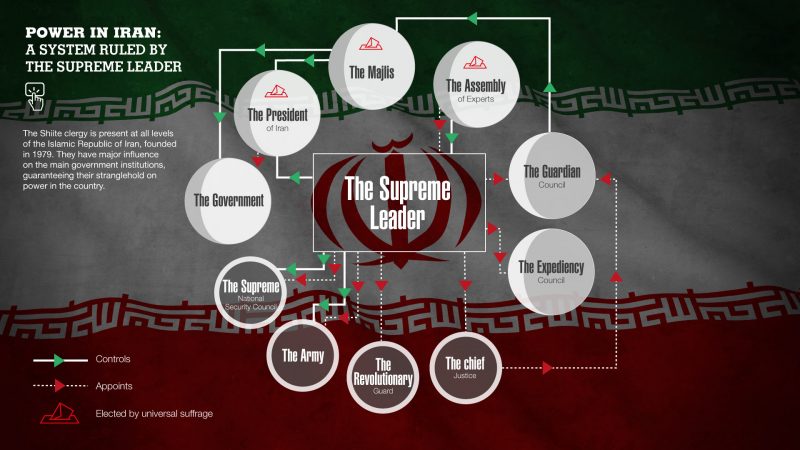
Contemporary experiences suggest that regime change poses an existential threat to the state, particularly in Iran and Syria. In these countries, the concept of regime intertwines with that of the state, making any attempt to overthrow the authority a threat to the very existence of the state itself.
Iran serves as a prominent example in this context, facing both internal and external challenges that threaten its stability. Since the Islamic Revolution in 1979, the Iranian state has become closely linked to the ruling regime, making any movement against the regime perceived as a threat to national security.
Event Details
In recent years, Iran has witnessed widespread protests against the government due to economic and social crises. These protests reflect a growing discontent with government policies, yet they are simultaneously viewed as a threat to the regime, which ties its survival to that of the state. In this situation, the Iranian regime struggles to adapt to popular demands, exacerbating tensions.
On another front, reports indicate that the Iranian regime employs force to suppress protests, leading to worsening humanitarian crises. This approach reflects the regime's connection to the existence of the state, as any movement against the regime is considered a threat to the unity of the country.
Background & Context
Historically, Iran has undergone significant political transformations, from the rule of the Shah to the Islamic Revolution. These transformations have contributed to shaping the identity of both the state and the regime, making it difficult to separate the two. At the same time, experiences from other countries like Syria highlight how ongoing conflict has eroded the concept of the state, rendering the ruling regime the sole representative of authority.
Experiences from other nations demonstrate that regime change can lead to chaos and internal conflicts, as seen in Libya and Iraq. These experiences underscore the importance of regime stability in maintaining state unity.
Impact & Consequences
The implications of this transformation extend beyond Iranian borders, affecting regional stability. Iran, as a pivotal state in the region, plays a crucial role in regional conflicts, and any threat to its existence could destabilize neighboring countries.
Moreover, the continuation of crises in Iran may encourage the escalation of conflicts in the region, threatening regional security. Neighboring countries, such as Iraq and Turkey, are closely monitoring the situation, as any changes in Iran could impact the balance of power in the region.
Regional Significance
Iran is considered a key player in Arab conflicts, supporting various groups in Iraq, Syria, and Lebanon. Any changes in the Iranian regime could affect these groups, leading to shifts in regional dynamics.
Additionally, the economic and social crises in Iran may result in a flow of refugees to Arab countries, posing an additional challenge for these nations. This situation requires Arab countries to take proactive measures to address any potential repercussions.
In conclusion, the Iranian model illustrates how a regime can become synonymous with the state, highlighting the complex challenges faced by countries in the region. Understanding these dynamics is crucial to avoiding future crises.