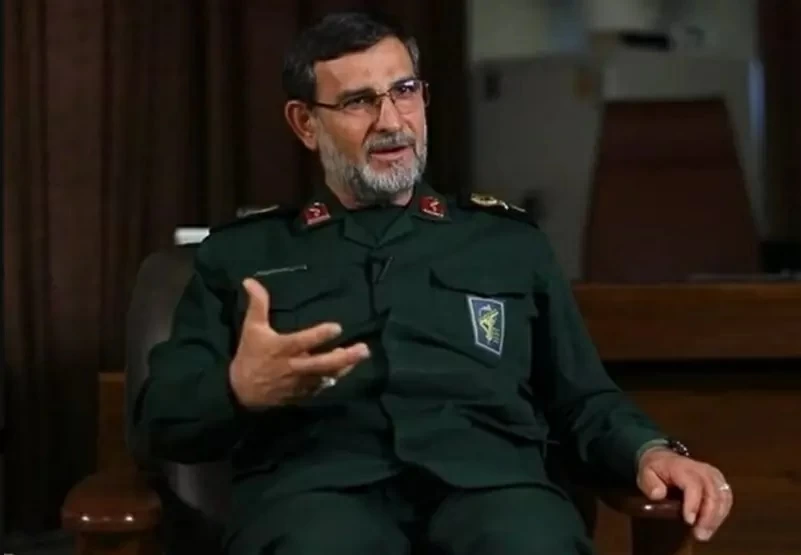
Local reports and Iranian news websites have confirmed today, Monday, the death of General Ali Geraghi, the head of the Information Protection Unit of the Iranian Internal Security Forces, in Khoramabad, the capital of Lorestan province in western Iran. The incident occurred as a result of an airstrike believed to have been carried out by Israel, although no official confirmation has been issued by Iranian authorities so far.
In a related context, the Iranian Revolutionary Guard confirmed in a statement today the death of Ali Reza Tangsiri, the commander of the naval forces, who succumbed to severe injuries. This announcement came four days after the Israeli Defense Minister confirmed Tangsiri's death in a precision-targeted operation. According to the Israeli official, Tangsiri was directly responsible for laying mines and closing the Strait of Hormuz, and he was targeted in Bandar Abbas.
Details of the Incident
These dramatic events in Iran unfold at an extremely sensitive time. General Ali Geraghi, who held a high-ranking position in internal security, is considered a prominent figure within the Iranian regime's structure. The airstrike that claimed his life signifies a notable escalation in Israeli military operations against Iranian targets, which are continuously increasing.
It is worth mentioning that the Iranian Revolutionary Guard announced the death of Tangsiri, who was serving as the naval forces commander, following a precise attack. These operations are part of an Israeli strategy aimed at undermining Iranian influence in the region, especially amid rising tensions in the Arabian Gulf.
Background & Context
Since the beginning of the war on February 28, Iran has witnessed repeated assassination operations targeting numerous military and political leaders, particularly from the Revolutionary Guard. Israeli airstrikes, in coordination with the United States, have led to the elimination of prominent figures such as Ali Khamenei, the Supreme Leader, Mohammad Pakpour, the commander of the Revolutionary Guard, and Abdul Rahim Mousavi, the chief of staff of the armed forces.
Historically, the relationship between Iran and Israel has been tense, with Israel accusing Iran of seeking to develop a nuclear program that could threaten its security. Conversely, Iran views Israel as an existential threat, leading to a continuous escalation in the conflict between the two parties.
Impact & Consequences
The repercussions of the deaths of Geraghi and Tangsiri extend beyond military dimensions, raising significant concerns in Tehran regarding internal security. Furthermore, Israeli operations may provoke retaliatory responses from the Revolutionary Guard, potentially escalating tensions in the region.
Moreover, these events could affect Iran's relations with other countries, as they may be used as a pretext to justify further repressive measures against domestic opponents or to bolster Iranian influence in regional conflicts.
Regional Significance
These developments are particularly significant for the Arab region, reflecting an escalation in the conflict between Iran and Israel, which may impact stability in Gulf countries. The increase in military operations could lead to heightened tensions between Arab states and Iran, especially with the presence of other regional powers like Saudi Arabia and the UAE, which view Iran as a threat to their security.
Ultimately, the situation in the region remains volatile, with expectations that military operations and assassinations will continue as part of the ongoing conflict between Iran and Israel, further complicating the security landscape in the Middle East.