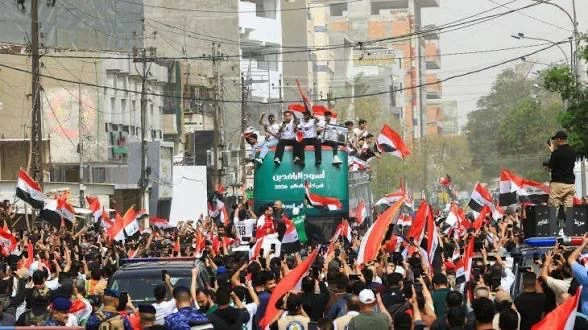
Iraq's national football team has qualified for the 2026 World Cup after a 40-year absence, securing a thrilling 2-1 victory over Bolivia in the global playoff final. The streets of the capital, Baghdad, witnessed massive celebrations as fans warmly welcomed the national team stars.
Prime Minister Mohammed Shia' al-Sudani greeted the team upon their arrival in the country, directing a public reception via an open-top bus that started from Freedom Square in Baghdad, allowing fans to express their joy over this historic achievement.
Details of the Event
The Iraqi team managed to secure the last qualifying spot for the World Cup after goals from Ali Al-Hamadi and captain Ayman Hussein during the match held in Monterrey, Mexico. This victory came after a long qualifying journey that spanned 21 matches, where the team achieved an exciting aggregate win of 3-2 over the UAE in Basra, paving the way for their competition in the global playoff.
Iraq has become the 48th team to qualify for the tournament, which will take place in the United States, Canada, and Mexico, and will play in Group 9 alongside France, Senegal, and Norway. The matches are scheduled to take place between June 11 and July 19 of the upcoming year.
Background & Context
This participation marks only the second time Iraq has qualified for the World Cup, with their previous appearance in 1986 in Mexico. Since then, the Iraqi team has faced numerous challenges in qualifying, making this achievement a pivotal moment in the history of Iraqi football.
This moment comes at a sensitive time for Iraqi sports, as the team seeks to rebuild itself after years of challenges. Qualification for the World Cup represents an opportunity to restore hope and enhance national spirit in the country.
Impact & Consequences
This sporting achievement will have positive effects on Iraqi society, boosting morale and uniting fans around a common goal. It also reflects Iraq's ability to compete on an international level, which may open doors for further investments in sports and infrastructure.
Qualification is expected to enhance sports tourism in Iraq, potentially attracting more visitors and fans during the tournament period, contributing to the support of the local economy.
Regional Significance
Iraq's qualification for the World Cup comes amid changing sports dynamics in the Arab region, where several Arab countries have seen successes in recent years. This achievement reflects the development of football in the region and enhances its standing on the international stage.
Moreover, Iraq's success in qualifying can serve as an inspiration for other Arab nations, demonstrating the possibility of achieving accomplishments despite challenges. This success is expected to strengthen sports relations among Arab countries.
In conclusion, Iraq's qualification for the 2026 World Cup represents a historic moment that reflects the strength of will and challenge, enhancing Iraq's status in the world of football.