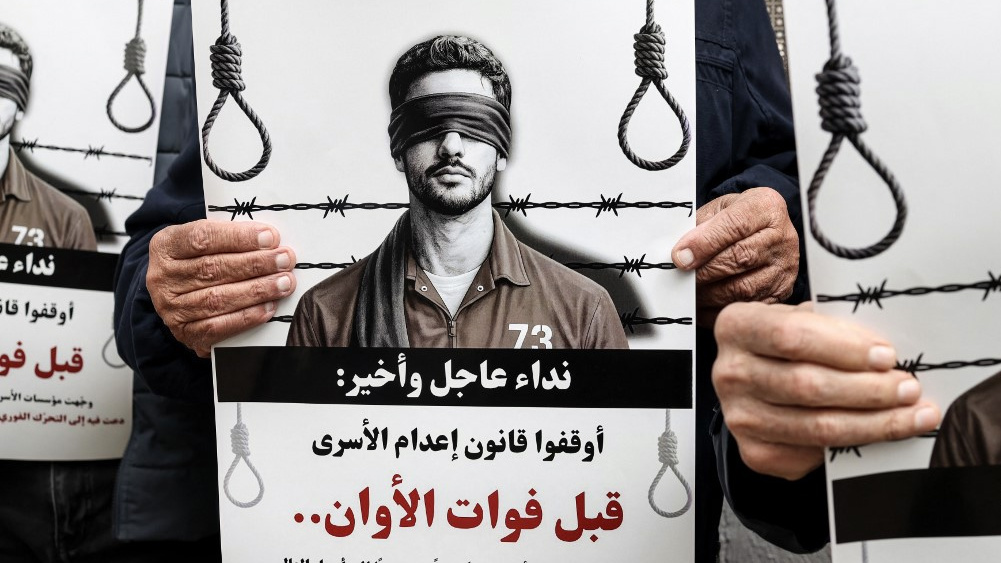
In a controversial move, the Israeli Knesset has approved a law that imposes the death penalty on any Palestinian convicted of premeditated murder in what is deemed a 'terrorist act.' This decision comes at a time when concerns about human rights in the occupied territories are escalating, as this law is seen as a blatant violation of basic rights such as the right to life and dignity.
The new law, which was passed despite over 2,000 objections, reflects the Israeli government's trend towards reinforcing repressive policies against Palestinians, and it enhances the use of law as a tool for governmental violence. Israeli National Security Minister Itamar Ben Gvir stated that this step is part of 'historic opportunities' to succeed in confronting what are considered security threats.
Details of the Law
The law mandates the death penalty for Palestinians convicted of 'terrorist' acts in military courts, with the possibility of reducing the sentence to life imprisonment in exceptional cases. In contrast, Israelis, including settlers, are tried in civilian courts, highlighting the legal gap between Palestinians and Israelis.
This legal discrimination reflects a dual judicial system, where Palestinians are considered second-class citizens, raising questions about justice and equality before the law. Furthermore, the law contradicts fundamental principles of international law, including the right to life.
Background & Context
Over the past decades, many countries around the world have moved towards abolishing the death penalty, viewing it as a cruel and inhumane punishment. However, the reintroduction of this penalty in Israel represents a regression from internationally recognized standards.
Historically, Israel has committed to international human rights standards, but this law marks a radical shift in its policy, as it is used as a tool to justify violence against Palestinians. In this context, the new law is part of a broader policy aimed at reinforcing Israeli control over the occupied territories.
Impact & Consequences
The implications of this law extend beyond Israeli borders, as it serves as a negative message to the international community regarding Israel's commitment to human rights. Additionally, this law could lead to an escalation of violence in the region, as it may be used as a pretext for further repression against Palestinians.
Moreover, this law may exacerbate feelings of frustration and despair among Palestinians, leading to an intensification of the conflict rather than achieving peace. The use of the death penalty as a deterrent does not support security but reflects a failure to address the root causes of the conflict.
Regional Significance
In light of these developments, concerns are growing about the impact of this law on neighboring Arab countries. This law is considered a blatant violation of human rights, which could provoke strong reactions from Arab nations and the international community.
Furthermore, this law may deepen divisions within Palestinian society, as it could be used as a justification for further violence. Ultimately, the current situation requires a coordinated response from Arab countries and the international community to pressure Israel to comply with international human rights standards.
In conclusion, the passage of the death penalty law in Israel represents a troubling step towards further repression and discrimination against Palestinians, reflecting a regression from fundamental humanistic principles that should be respected in any civilized society.