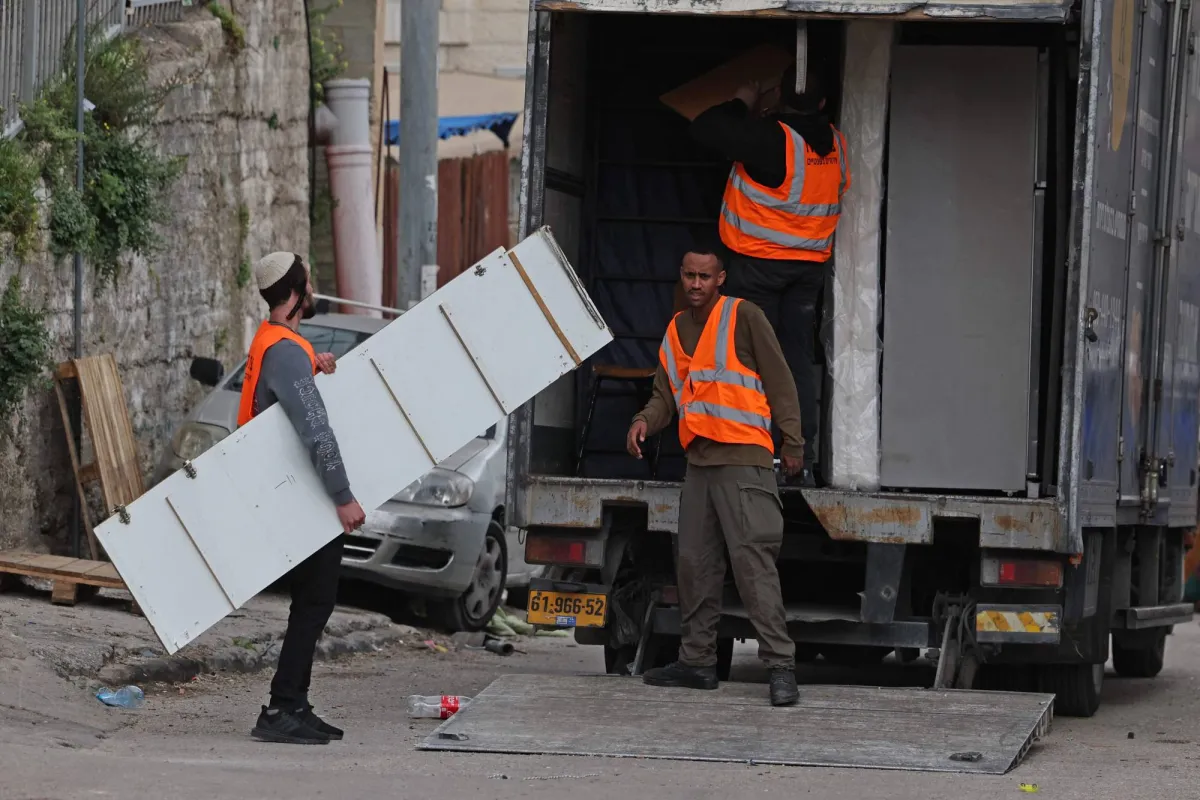
On Wednesday, Israeli authorities carried out forced evictions against 11 Palestinian families in the Batn al-Hawa neighborhood of Silwan in East Jerusalem, benefiting settlers. The human rights organization B'Tselem and a reporter from the Agence France-Presse confirmed that this step is part of an Israeli policy aimed at strengthening the settlement presence in the area.
The eviction decisions are based on a law enacted in 1970, which allows Jews who lost their properties before the establishment of Israel in 1948 to reclaim them. They are also based on documents dating back to the 19th century and the Ottoman era, indicating that Jews of Yemeni descent lived on those lands before leaving during the Palestinian revolts between 1929 and 1936.
Details of the Eviction
In a statement issued by B'Tselem, it was noted that a large Israeli force entered the Silwan neighborhood to evict the 11 Palestinian families from their homes. The settlers brought in to carry out the eviction threw the families' belongings out of the windows, under the protection of Israeli forces. During the operation, Israeli forces completely closed off the neighborhood and restricted movement within it.
According to B'Tselem, the eviction represents the beginning of a widespread displacement wave affecting around 2,200 people in Silwan, with 90 families (comprising 700 individuals) in Batn al-Hawa facing an imminent threat of forced displacement. Israeli authorities have previously evicted Palestinian families from the neighborhood, and other families are awaiting the implementation of eviction orders.
Context and Background
The town of Silwan is considered part of East Jerusalem, which was occupied by Israel in 1967 and subsequently annexed in a move not recognized by the international community. Hundreds of settlers live in Silwan among approximately 50,000 Palestinians, with their homes distinguishable by the Israeli flags raised on rooftops and windows, in addition to surveillance cameras installed on them.
Through these measures, Israel seeks to alter the demographic balance in the area, reflecting a policy of Judaization of the neighborhood and exploiting discriminatory laws. The presence of settlers in Silwan is deemed illegal under international law, which prohibits an occupying power from transferring its population into occupied territories.
Consequences and Impact
Reports indicate that these eviction operations are part of a broader campaign of ethnic cleansing in the West Bank, where Israel aims to expand its presence in politically and religiously sensitive areas. This has sparked angry reactions from Palestinians and human rights supporters, who view these policies as a blatant violation of Palestinian rights.
Concerns are growing that these actions may escalate tensions in the region, especially amid the politically charged conditions in the Palestinian territories. Many observers believe that these policies aim to undermine any possibility of reaching a peaceful resolution to the Israeli-Palestinian conflict.
Impact on the Arab Region
These events are part of the ongoing conflict between Palestinians and Israelis, which directly affects stability in the region. The continuation of eviction and displacement operations could exacerbate the humanitarian situation in the Palestinian territories, necessitating international intervention to pressure Israel to halt these policies.
Ultimately, the Palestinian issue remains one of the most complex issues in the world, intertwining political, religious, and humanitarian dimensions. What is happening in Silwan serves as another reminder that the conflict is not over, and there is an urgent need to seek just and lasting solutions.