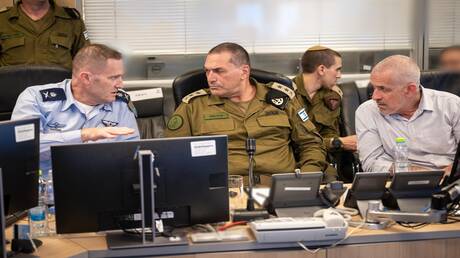
Israeli Chief of Staff Eyal Zamir announced on Sunday that military operations against the Lebanese group Hezbollah have commenced, predicting their continuation beyond the Iranian conflict. These remarks come at a sensitive time when the region is witnessing escalating tensions between Israel and its allies on one side, and the Iran axis and its allies on the other.
Zamir emphasized that the Israeli army is prepared to face upcoming challenges, indicating that this battle will not be limited to confronting Hezbollah alone, but will also encompass risks arising from Iranian activities in the region, which have significant implications for Israeli security.
Details of the Event
Zamir's statements are part of pivotal remarks indicating strategic changes in the Middle East, where Hezbollah, supported by Iran, faces new challenges due to military and political developments. Zamir stressed the Israeli army's determination to counter any potential threat, suggesting further escalation in the ongoing conflict.
This step is part of a broader Israeli strategy aimed at achieving comprehensive military superiority against Hezbollah and Iran, as the Israeli army seeks to enhance its strategic presence along the northern borders, in accordance with current military and political data.
Background & Context
In recent years, Hezbollah has witnessed a notable improvement in its military capabilities, thanks to ongoing Iranian support. As is well-known, Hezbollah has organized its ranks comprehensively and prepared new equipment for combat, making it one of the strongest armed groups in the region. In contrast, Israel continuously seeks to confront these challenges by strengthening its defenses and offensive strategies.
The regional dispute over Iranian influence has further complicated the conflict. With Iran's increasing involvement in conflicts in Syria, Iraq, and Yemen, Israel views confronting Hezbollah as part of a broader battle against this influence that threatens its national security.
Impact & Consequences
The Israeli General Staff anticipates that the ongoing conflict against Hezbollah may have repercussions on the country's internal and external security situation. Should confrontations escalate, the northern borders could witness armed clashes leading to greater tensions in the region, affecting neighboring countries such as Lebanon and Syria.
Moreover, the ability to manage the battle effectively will demonstrate Israel's combat readiness and its capacity to confront new military alliances that may emerge as a result of these tensions. Relying on accurate intelligence and executing effective military operations will remain vital to achieving the specified Israeli objectives.
Regional Significance
Zamir's statements may serve as a wake-up call for neighboring Arab countries, as everyone cautiously monitors Israeli military movements and their potential outcomes on regional security. An escalation of the conflict could impact stability in Lebanon, fuel violence in Syria, and widen the gap among political factions in the region.
Furthermore, the Arab community must remain aware of the shifts in the conflict and changes in power dynamics that may affect the national security of Arab states. The rising security challenges may prompt Arab countries to reconsider their defense policies and international relations.
In conclusion, Israeli military strategic assessments appear contingent on the evolution of field conditions, while the conflict is viewed as one of the central axes serving Israel's vision to maintain its security and stability in a complex region where various powers interact.