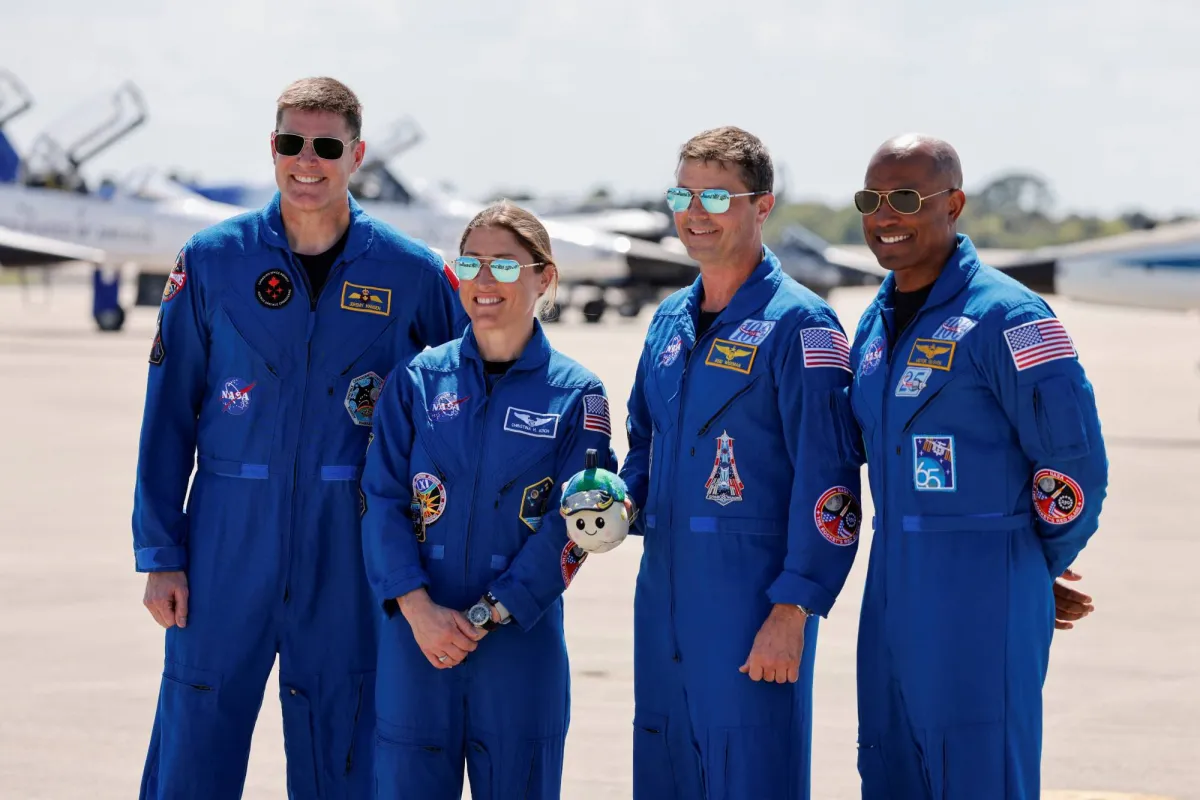
NASA is gearing up to launch the Artemis 2 mission, which will witness four astronauts flying around the moon, marking the first mission of its kind in over half a century. In an innovative step, they will be accompanied by a new stuffed doll named Rise, designed by a second-grade student.
Rise features a soft ball size and wears a baseball cap adorned with symbols inspired by the pioneering Apollo 8 mission that launched in 1968. This doll serves an important scientific function, acting as a zero-gravity indicator, helping astronauts visually confirm their entry into the zero-gravity environment of outer space.
Event Details
Rise was selected from over 2,600 designs in NASA's Moon Mascot competition, created by Lucas Yee, a second-grade student from Northern California. The doll contains a memory card with the names of 5.6 million people from around the world, adding a human dimension to this historic journey.
The doll is decorated with an image of Earth, two launching rockets, and twinkling stars, inspired by the famous Earthrise photo taken by astronaut Bill Anders during the Apollo 8 mission. Astronaut Christina Koch confirmed that this symbolism aligns with the spirit of the mission, representing the values and ethics embraced by the team.
Background & Context
The Apollo 8 mission was the first space mission to carry humans to the moon and bring them back to Earth, as its crew orbited the far side of the moon. Astronauts Frank Borman, James Lovell, and William Anders spent about 20 hours orbiting the moon before returning to Earth after a journey lasting over 6 days.
Artemis 2, the second flight in the Artemis program, aims to achieve new historic milestones, with Christina Koch expected to become the first woman to go to the moon, while Victor Glover will become the first Black man to achieve this feat. Additionally, Jeremy Hansen, the Canadian astronaut, will be the first non-American to accomplish this milestone.
Impact & Consequences
The Artemis 2 mission is a significant step toward achieving larger goals in space exploration, as NASA aims to establish a permanent base on the moon. If the mission proceeds smoothly, the next phase of the program is expected to launch in 2027.
This scientific achievement not only reflects technological advancement but also enhances international cooperation in space, with astronauts from various nationalities participating in this historic mission. The success of this mission could open new horizons for exploring other planets and emphasize the importance of education and innovation in science and technology.
Regional Significance
This mission serves as an inspiration for Arab countries, potentially encouraging youth to engage in science and engineering fields. Space exploration represents an opportunity to enhance cooperation among Arab nations in scientific research and technology, contributing to the region's development in this vital area.
In conclusion, the Artemis 2 mission represents a significant step toward a bright future in space exploration, where innovation and inspiration converge in a historic journey around the moon.