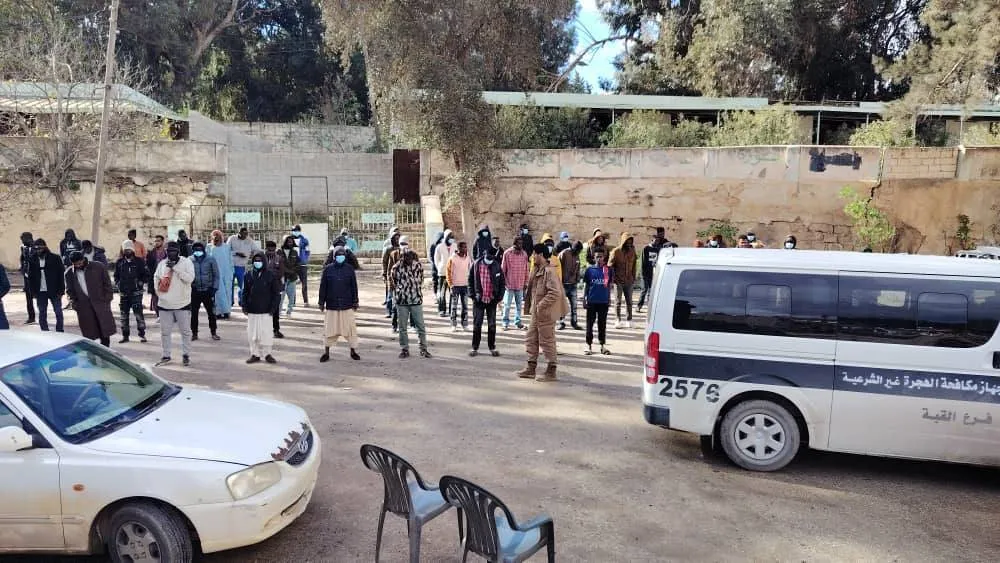
Lieutenant General Salah Al-Khafifi, head of the Illegal Migration Combat Agency in eastern Libya, revealed the necessity of opening channels of cooperation with the European Union to tackle the phenomenon of irregular migration. Al-Khafifi affirmed that the risks posed by this phenomenon to regional and global security require all parties to collaborate with Libya.
In his statements, Al-Khafifi pointed out that cooperation in this area remains below expectations, despite the significant challenges facing Libya as a transit country suffering from political and military division, complicating efforts to control irregular migration.
Details of the Event
In an interview with Al-Sharq Al-Awsat newspaper, Al-Khafifi added that the General Command of the Libyan National Army provides the necessary material resources for the agency's operations, indicating that there is no need for financial support from the European side. However, he emphasized the importance of training cooperation with European countries.
It is noteworthy that the issue of irregular migration was a focal point of discussions held by Greek Foreign Minister George Gerapetritis in Benghazi, where he met with the Commander of the National Army, Marshal Khalifa Haftar, and his son, Chief of Staff General Khaled Haftar.
Context and Background
Since the fall of the late President Muammar Gaddafi's regime in 2011, Libya has become a major transit point for thousands of irregular migrants heading to Europe, leading to repeated incidents of drowning and fatalities along this route. According to the latest displacement tracking matrix data, there are 939,638 migrants recorded in Libya, the highest number since monitoring began.
Despite this, Al-Khafifi considered the figures released by the International Organization for Migration, which indicate around one million migrants in the country, difficult to confirm accurately. He explained that official figures show that detention centers accommodate about 7,000 irregular migrants, and 41,000 individuals were deported last year.
Challenges and Security Implications
Libya faces significant security challenges, especially in the south, where the southern borders pose a security concern due to smuggling threats and armed activity. Chief of Staff Khaled Haftar previously stated that the National Army stands ready to confront any attempts to violate the borders.
Al-Khafifi also noted that the desert patrols of the Illegal Migration Combat Agency provide an important security cover, as a shipment of weapons was recently seized in the border area between Libya, Egypt, and Sudan.
Impact on the Arab Region
Libya has been suffering from political and security divisions since 2011, with power shared between two governments, one in the west led by Abdul Hamid Dbeibah and the other in the east supported by the National Army. Despite these divisions, Al-Khafifi described the issue of irregular migration as a national security matter that should transcend political disputes.
In this context, the agency's branch in the city of Al-Qubah announced the implementation of an intensive security campaign aimed at reducing the phenomenon of migration and controlling violations by newcomers within the city, reflecting the ongoing efforts of Libyan authorities to address this issue.