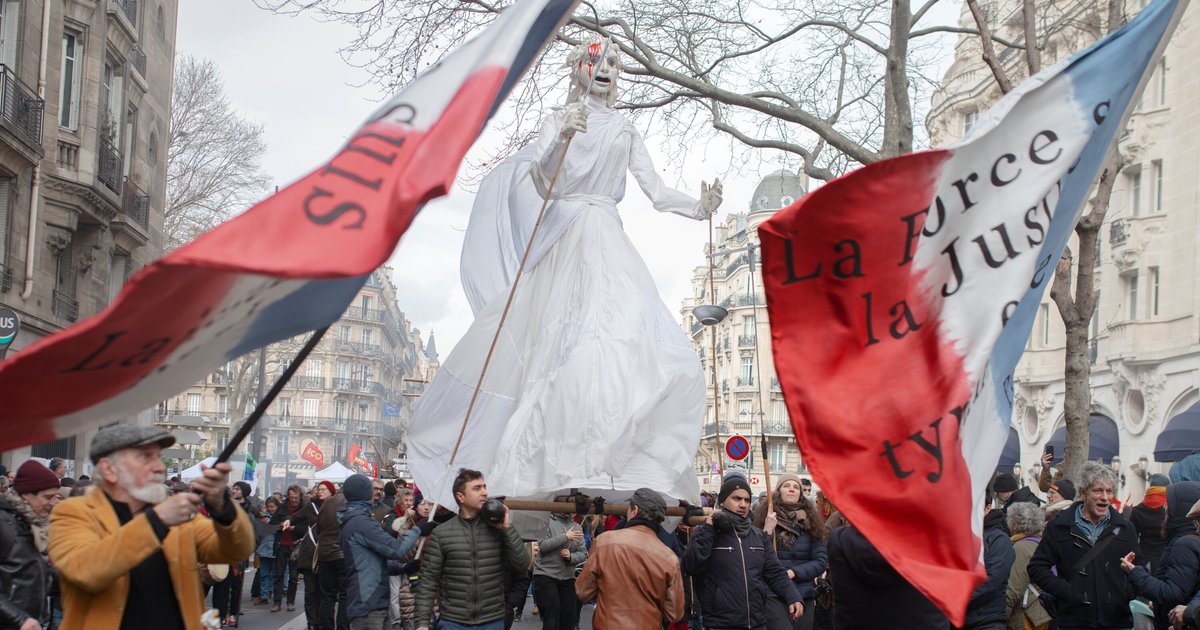
Last Saturday, France saw massive protests across various cities, with thousands of demonstrators gathering in the streets of Paris and other locations to oppose the new labor law enacted by the French government. This movement arises during a critical period, as protesters express their fears regarding the law's implications for workers' rights and working conditions in the country.
The new law, aimed at simplifying hiring and firing procedures, has sparked widespread controversy among labor unions and political parties. Many view it as a step towards diminishing workers' rights and undermining the gains achieved over the years.
Details of the Protests
Protesters gathered at the Place de la République in Paris, holding banners demanding the repeal of the new law. Numerous labor unions participated in the demonstrations, including the General Confederation of French Labor (CGT), which has called for widespread strikes in the coming days if the government does not retract the law.
Similar protests were also witnessed in cities such as Lyon, Marseille, and Bordeaux, where participants expressed their dissatisfaction with the government's economic policies, which they believe favor large corporations at the expense of workers' rights.
Background & Context
Historically, France has experienced numerous protests against labor laws, as the French consider workers' rights to be a fundamental part of their national identity. In 2016, similar demonstrations occurred against a labor law enacted by the government at that time, which aimed to reform the labor market.
These protests come amid a severe economic crisis affecting the country, with unemployment rates rising significantly in recent years, exacerbating social tensions. The government is also facing increasing criticism for its handling of the economic crisis and its impact on the poor and middle classes.
Impact & Consequences
These protests are expected to influence the French government, which may be compelled to reconsider some of its economic policies. The continuation of protests could further escalate social conditions, potentially negatively impacting political stability in the country.
These demonstrations present an opportunity for labor unions to regroup and strengthen their position against the government, possibly opening the door for renewed dialogue regarding workers' rights and labor policies in France.
Regional Significance
The protests in France serve as an example of how communities react to economic policies that affect individual rights. In the Arab world, many countries have witnessed similar protests against economic policies perceived as unjust by the public. These events may inspire activists in Arab nations to continue advocating for their rights.
In conclusion, the situation in France remains under close observation, as the government's responses to these protests will determine the fate of the new labor law and whether it will lead to real changes in economic policies.