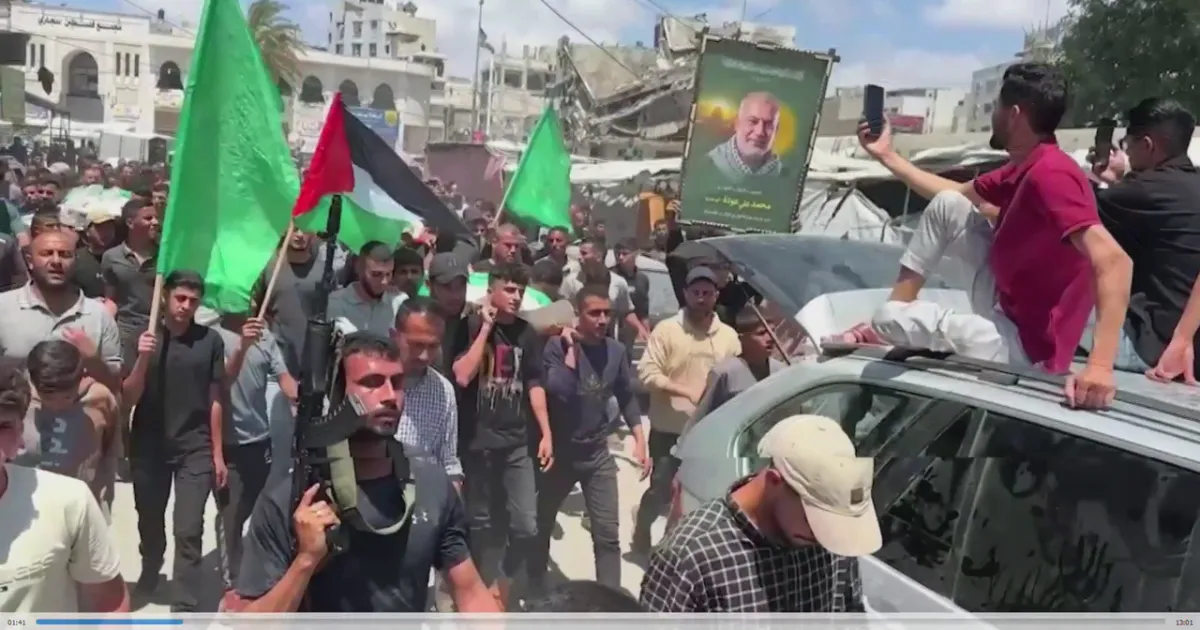
On Wednesday, Palestinians in Gaza mourned the bodies of Hamas leader Muhammad Awda, his wife, and two of their sons, who were killed in an Israeli airstrike targeting their residential apartment in the Rimal neighborhood on Tuesday evening. The funeral procession, which began at the medical complex, saw a large turnout, with the bodies carried on shoulders amidst chants calling for resistance.
The funeral procession reached the Baptist cemetery east of Gaza City, where Awda was laid to rest. One of the speakers delivered a eulogy for Awda, stating that the path to Jerusalem can only be opened through men and blood, considering that the "Tsunami of Al-Aqsa" represents a battle for liberation and breaking chains.
Details of the Funeral
During the funeral rites, mourners chanted slogans such as "There is no god but Allah, and the martyr is beloved by Allah," while gunfire was heard as the procession moved through the streets of Gaza. One speaker, known as "Abu Musab," emphasized that Awda spent many years preparing and fighting, asserting that Hamas will continue despite the assassinations.
Meanwhile, Al Jazeera Mubasher correspondent Muath Al-Amour reported that the families of the martyrs began preparing the funeral processions early in the morning, with the bodies departing from the medical complex towards Al-Noor Mosque before being buried in Sheikh Radwan cemetery in the northern part of the city. He also noted that another Palestinian woman was killed in the bombardment and was buried earlier.
Background & Context
These events occur amid the ongoing escalation between Israel and Palestinian factions in the Gaza Strip, where Israeli airstrikes have targeted numerous homes, resulting in a significant number of casualties. Since the onset of the war in October 2023, Israel has continued its military operations in the enclave, leading to the deaths of tens of thousands of Palestinians, according to data from the Gaza Health Ministry.
The Israeli army announced that it assassinated Muhammad Awda in a strike conducted in the northern Gaza Strip, claiming he was one of the last senior leaders overseeing the planning of the October 7 attack. These statements come at a time when international accusations against Israel of committing widespread violations against civilians are increasing.
Impact & Consequences
Israeli airstrikes continue despite a ceasefire agreement reached in October 2025, raising concerns among Palestinians who live in a state of tension and fear. Many relatives of the martyrs expressed feelings of anger and sorrow, asserting that what is happening represents a continuous violation of the agreement.
The recent events reflect an escalation in violence, impacting the humanitarian situation in Gaza, where residents endure difficult conditions, with an increasing need for humanitarian aid. The continuation of military operations complicates peace efforts in the region.
Regional Significance
These events are part of the Israeli-Palestinian conflict, which affects stability in the Arab region. Concerns are growing that these escalations may lead to new waves of violence, threatening regional security.
Additionally, reactions to these events may impact relations between Arab countries and Israel, as pressures mount on Arab governments to intervene to stop the violence and protect civilians.