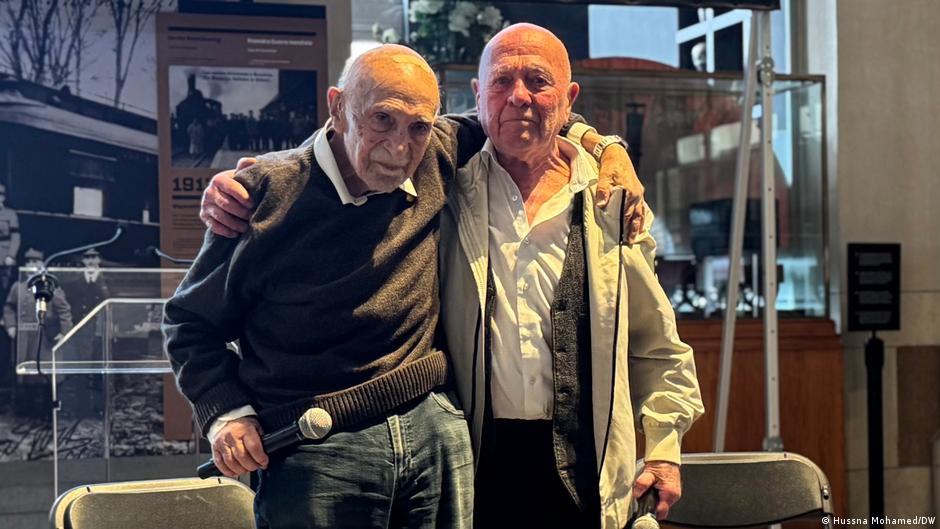
The Brussels Train Museum hosted an impactful event earlier this week, where the hall was filled with two elderly men, one a Holocaust survivor and the other the son of a Nazi collaborator. The event, organized by the German embassy in collaboration with the museum, gathered over 180 students, who exchanged personal experiences reflecting the atrocities of the past.
Simon Grunowski, a 94-year-old lawyer, shared his painful memories from March 1943 in the Belgian city of Antwerp. He recounted, "It was breakfast time, the doorbell rang, we all looked at each other, I was with my mother and sister, and we found ourselves paralyzed. All our plans to escape through the backyard were in vain." His family was captured by the Gestapo, and a month later, on April 19, 1943, they were transported to Auschwitz by the Nazis.
Details of the Event
During his talk, Grunowski recalled how his mother helped him escape from the train, saying, "She gently lowered me until I placed my feet on the edge of the carriage, then pushed me out when the train slowed down." While he managed to escape, his mother and sister could not, and they were killed in the gas chambers at Auschwitz. It is estimated that around 6 million Jews were killed during the Holocaust, including approximately 1.1 million at Auschwitz.
Alongside Grunowski was Konrad Tinel, a 92-year-old caricaturist who grew up in an extreme Nazi environment. He stated, "I was born into a radical Nazi environment, and my father was a camp chief in France." Tinel, who was six years old when the Holocaust began, severed ties with his family and dedicated his life to documenting his experiences.
Background & Context
The exhibition relates to the role of Belgian railways during the Nazi occupation, where trains were used as a tool for deportation. Following the German invasion of Belgium in May 1940, the German railway administration took control of the Belgian network. This control raised difficult questions about how the system operated smoothly in organizing deportation operations.
According to historian Nico Wouters, the Belgian National Railway (SNCB) took on significant responsibilities during the occupation, as it was obliged to cooperate with the occupying forces. Between 1941 and 1944, the Belgian railways assisted in the deportation of approximately 189,542 forced laborers, 25,490 Jews, 16,081 political prisoners, and 353 Roma to Germany and concentration camps in the East.
Impact & Consequences
These testimonies highlight the importance of historical memory, as both Grunowski and Tinel urged students to learn from the past and not repeat mistakes. Grunowski emphasized, "Despite everything, I have never felt hatred. Hatred will not bring my mother and sister back to me." This appeal underscores the importance of education and awareness in combating extremism.
Tinel also pointed out the necessity for the new generation to understand what happened in the past, stating, "I want to witness what happened, and I want people to understand that what they did was very dangerous and wrong."
Regional Significance
The significance of these testimonies extends beyond Belgium, reminding us of the dangers of extremism and hatred that can lead to similar atrocities. In the Arab region, many countries face challenges related to extremism and discrimination, making it essential to promote a culture of tolerance and understanding among cultures.
In conclusion, this event serves as a call to reflect on the importance of history and its role in shaping the present and future. We must remember that learning from the past is the only way to ensure that tragic mistakes are not repeated.