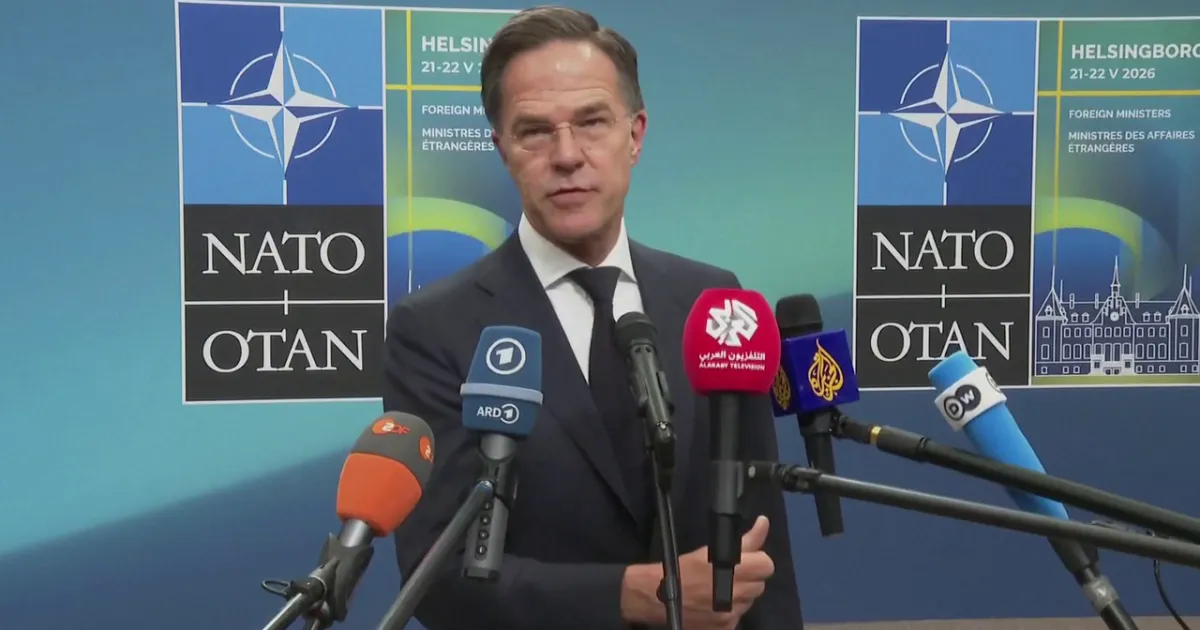
NATO foreign ministers gathered in Sweden as U.S. pressures on the alliance intensified due to criticisms regarding the lack of cooperation among member states in addressing Iranian threats. NATO Secretary General Mark Rutte announced that many European countries expressed their willingness to contribute to efforts aimed at reopening the Strait of Hormuz and ensuring freedom of navigation in the region.
Rutte clarified that European nations informed Washington about the potential use of European military bases in U.S. operations, noting that countries such as Romania, Greece, Portugal, France, the United Kingdom, and Germany have already begun taking practical steps in this direction.
Details of the Meeting
During the meeting, developments regarding the war with Iran and the security of navigation in the Strait of Hormuz were discussed. Rutte emphasized that NATO is capable of playing a direct role in protecting the global economy from the repercussions of a closure of the strait, pointing out that some European nations have sent mine sweepers and naval ships to support these efforts.
He also stressed that NATO is a democratic political and military alliance, and its decisions are made by consensus, contrasting this with what he described as the approaches of China and Russia in managing alliances.
Background & Context
Amid escalating tensions, U.S. Secretary of State Marco Rubio intensified his criticisms of the alliance, questioning the effectiveness of the military alliance in light of disagreements over the U.S.-Israeli war against Iran. Rubio pointed out President Donald Trump's dissatisfaction with member states that did not allow the use of U.S. military bases.
Spanish Foreign Minister José Álvarez reaffirmed his country's full commitment to NATO decisions, noting an increase in defense spending to over 2% of GDP. He also confirmed that Spain is participating in several military missions from Iraq to the Mediterranean.
Impact & Consequences
French Foreign Minister Jean-Noël Barrot highlighted the need to enhance European capabilities amid the rescheduling of U.S. troop deployments in Europe. He also discussed the French military presence in the Mediterranean to protect French citizens and Paris's allies in the Gulf region.
Barrot confirmed that disruptions in the Strait of Hormuz have serious implications for the global economy, stating that France is directly involved in efforts to restore navigation flow in coordination with the U.S. administration.
Regional Significance
Concerns are growing regarding the impact of tensions in the Strait of Hormuz on the Arab region, as the strait is a vital artery for global trade. European foreign ministers affirmed their readiness to enhance military cooperation, which could contribute to regional stability.
In conclusion, the current meeting reflects the challenges facing NATO under U.S. pressures and underscores the importance of European cooperation in addressing security threats in the region.