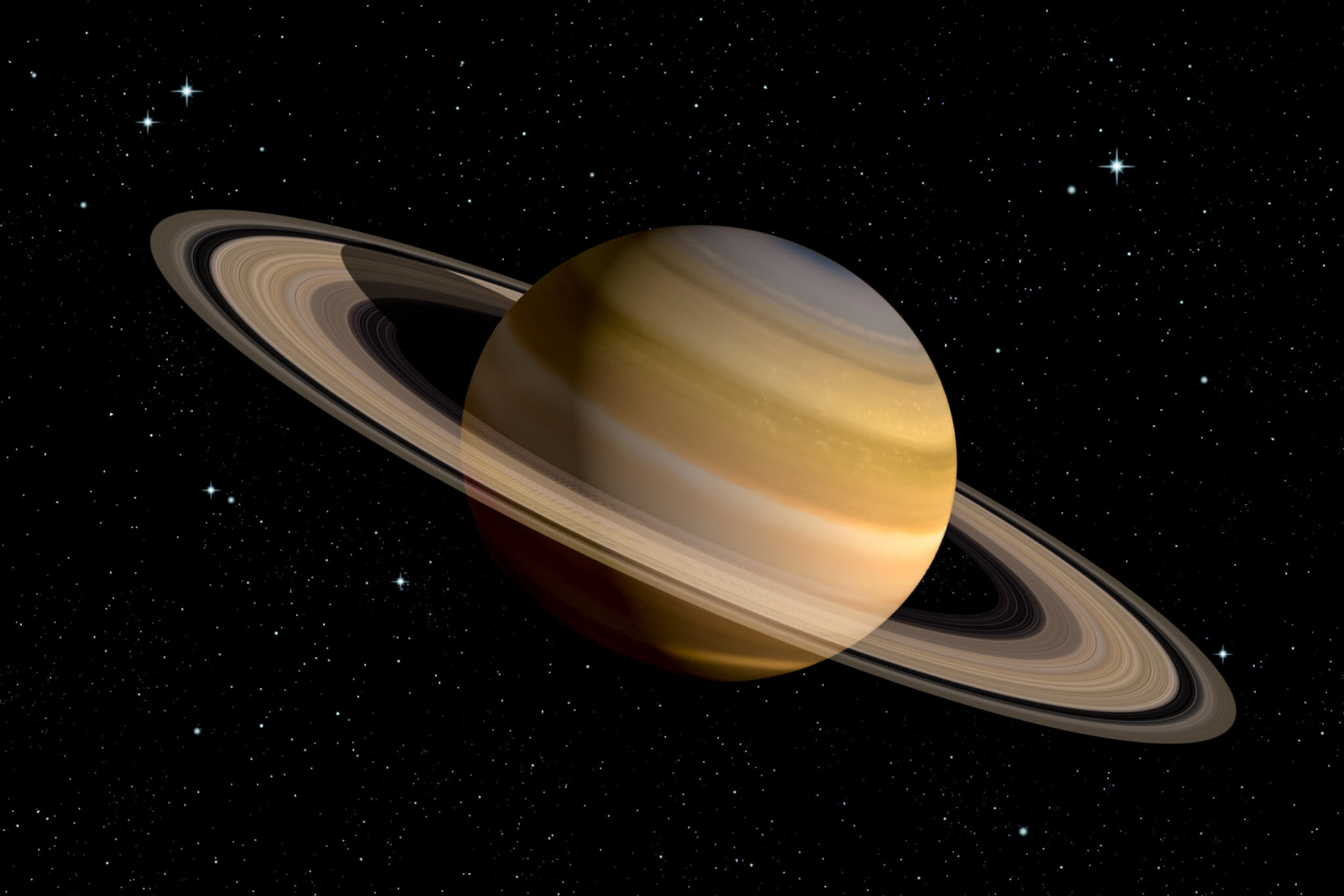
Recent research presented at the Lunar and Planetary Science Conference held in Texas reveals that Saturn's famous rings may be remnants of an ancient moon known as 'Chrysalis', which shattered approximately 100 million years ago. This violent cosmic event altered the planet's shape and tilt, opening new avenues for understanding Saturn's history.
Researchers believe that the moon 'Chrysalis' orbited Saturn for billions of years in a stable orbit before entering a critical phase of orbital disruption. Over time, the moon gradually approached Saturn until it crossed a critical threshold known as the 'Roche limit', where immense gravitational forces begin to tear apart nearby bodies.
Details of the Event
Upon exceeding the 'Roche limit', there was no sudden explosion; instead, a gradual and violent disintegration occurred. The outer icy layers of the moon were torn apart and separated, while its heavier rocky components were drawn towards the interior of Saturn. According to the 'Chrysalis' model, the separated icy materials remained in orbit and gradually spread out to form the bright and pristine rings we see today, while the heavy rocks disappeared into the planet's core.
The current rings appear much smaller compared to the mass of the original system before the disintegration, as large moons like Titan contributed to the redistribution of material and gradually reduced the mass of the rings.
Background & Context
There are two main theories explaining the formation of Saturn's rings. The first posits that the rings formed from an ancient moon that shattered billions of years ago, but this theory faces a challenge; the rings should have become dark and covered in dust after billions of years of cosmic bombardment, while they appear almost pristine today.
The second theory suggests that the rings originated from a moon that failed to form, but this hypothesis assumes that the rings are very old, which contradicts recent evidence indicating that their age does not exceed hundreds of millions of years.
There is also a third idea that suggests the rings came from comets or icy bodies that collided with Saturn, but this notion struggles to explain the large quantity of material and its pure icy nature.
Impact & Consequences
The 'Chrysalis' model provides comprehensive explanations for a range of mysteries associated with Saturn's rings, including their origin, icy purity, and recent age. It also explains Saturn's axial tilt of 26.7 degrees, as the moon was part of a gravitational system with the planet Neptune, which helped stabilize Saturn's tilt for a long time.
As the moon tore apart and a portion of it shattered, the balance gradually shifted, leading to the planet's tilt to its current position. This hypothesis offers integrated explanations for more than one mystery in the solar system.
Regional Significance
These scientific discoveries are significant not only for understanding Saturn but also for enhancing scientific knowledge in the Arab world. Such research can inspire new generations of scientists and researchers in the fields of space and physics.
While this hypothesis is still under study and verification, it is currently the most comprehensive and convincing in explaining one of the most beautiful cosmic sights: Saturn's rings.