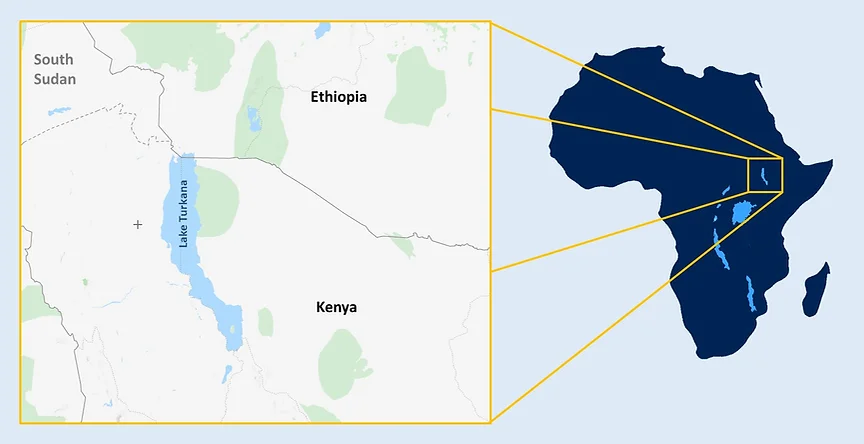
A significant geological development has emerged from a recent study revealing new evidence that may alter scientists' understanding of East Africa's history, particularly in the Turkana Rift area. The study, published on April 23 in the journal Nature Communications, indicates that the Earth's crust in this region has become much thinner than previously believed, signaling the possibility of a future continental split.
The research focuses on an area known as the Turkana Rift, which is part of a vast system of geological fractures extending across East Africa from Ethiopia in the north to Mozambique in the south. This system, known as the East African Rift, is one of the most important sites on the planet for studying how continents break apart.
Study Findings and Implications
The study revealed that the thickness of the Earth's crust in the Turkana Rift area is only about 13 kilometers, compared to over 35 kilometers in surrounding regions. The lead author of the study, Christian Rowan, a PhD student at the Lamont-Doherty Earth Observatory at Columbia University, stated, "You can imagine the Earth's crust as a solid layer covering the planet; as this layer slowly stretches, it becomes thinner and weaker, much like a piece of dough being pulled from both ends."
Tectonic plates in East Africa are moving away from each other at a rate of approximately 4.7 millimeters per year. While this may seem small, over millions of years, it is sufficient to completely reshape the continents. Researchers describe this phase as critical, as the crust has become weak enough to allow for potential separation in the future, which could lead to the formation of a new ocean.
Background & Context
Historically, the East African region has witnessed previous attempts at continental splitting, having undergone similar phases of extension that were not completed, leaving the crust weaker than before. This indicates that the continent does not split in a single sudden event, but rather goes through a series of attempts over time, making the crust more fragile with each phase.
The Turkana region is one of the richest fossil sites in the world, with over 1,200 fossils discovered, representing a significant portion of Africa's paleontological finds. Researchers believe that volcanic activity around 4 million years ago contributed to changes in the landscape, aiding in the preservation of bones and organic remains for extended periods.
Impact & Consequences
The significance of these findings extends beyond geology, impacting our understanding of human history. East Africa could serve as a natural archive for human history, opening new avenues for research and study in this field.
These results suggest that what is happening in East Africa may have far-reaching implications for our understanding of human history, as geological conditions could help preserve historical evidence that may assist in understanding human evolution.
Regional Significance
This discovery holds particular importance for the Arab region, as geological studies could contribute to understanding climate and environmental changes that may affect the area. Additionally, geological changes in East Africa could influence climate patterns in neighboring countries, necessitating further research and regional cooperation.
In conclusion, this study opens new horizons for understanding the history of the Earth and humanity, reflecting the importance of scientific research in exploring the secrets of our planet.