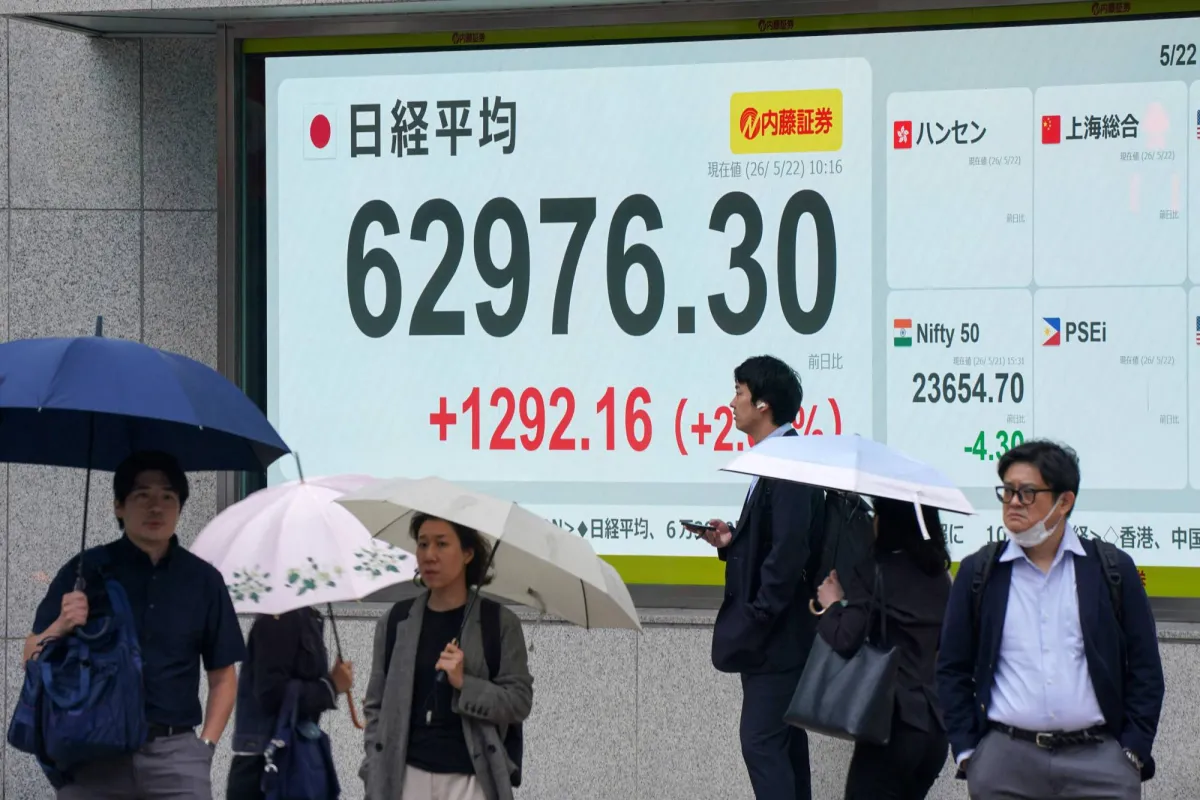
The Japanese Nikkei index achieved a record high on Friday, closing up by 2.7% at 63,339.07 points. This surge was driven by significant gains in artificial intelligence stocks, reflecting the influence of the U.S. market on local performance.
Although the index did not surpass its intraday peak of 63,799.32 points reached on May 14, the overall performance remained strong. Additionally, the broader Topix index rose by 1% to close at 3,892.46 points.
Details of the Event
The Philadelphia Semiconductor Index, a key U.S. benchmark for chip manufacturing stocks, rose by 1.3% overnight, bolstering Japanese equities. These stocks rebounded after hitting multi-week lows on Wednesday, supported by reports indicating the potential end of the Iranian conflict, which contributed to lower oil prices and global bond yields.
In a report from Bank of America, strategists Masashi Akutsu and Tetsuhiro Takuyama noted that the correction in Japanese stocks, particularly in AI shares, may persist longer, but they do not expect it to be sharp or prolonged. They emphasized their preference for AI-related stocks and maintained a positive outlook on the Japanese market.
Background & Context
SoftBank Group's AI investments are among the largest contributors to the Nikkei index, accounting for 578 points of the index's total gain of 1,655 points, marking an increase of 11.9%. Tokyo Electron, a company specializing in chip manufacturing equipment, also saw gains after recovering from initial losses, finishing the day up by 2.1%.
On another note, the performance of Japanese government bonds varied, as long-term bond yields fell due to optimism surrounding the potential end of the Iranian conflict, while short-term bond yields rose amid speculation of the Bank of Japan tightening its monetary policy.
Impact & Consequences
Long-term Japanese bond yields were affected by market fluctuations, with the yield on 30-year Japanese government bonds dropping by two basis points to 4%, while the yield on 40-year bonds decreased by 3 basis points to 4.21%. In contrast, the yield on 20-year bonds remained stable at 3.69%.
Finance Minister Satsuki Katayama indicated that the government would seek to avoid excessive reliance on new debt issuance if preparing an additional budget to address rising prices. Recent data also showed that core inflation in Japan reached its lowest level in four years, reflecting the impact of government support on prices.
Regional Significance
The strong performance of the Nikkei index signals stability in financial markets across Asia, which could positively influence Arab investments in global markets. The shift towards artificial intelligence also reflects a transformation in global economies, potentially opening new avenues for cooperation between Arab nations and Japan in this field.
In conclusion, the performance of the Japanese market remains under observation, with forecasts suggesting that continued investments in modern technology could contribute to economic growth in Japan and influence global markets overall.