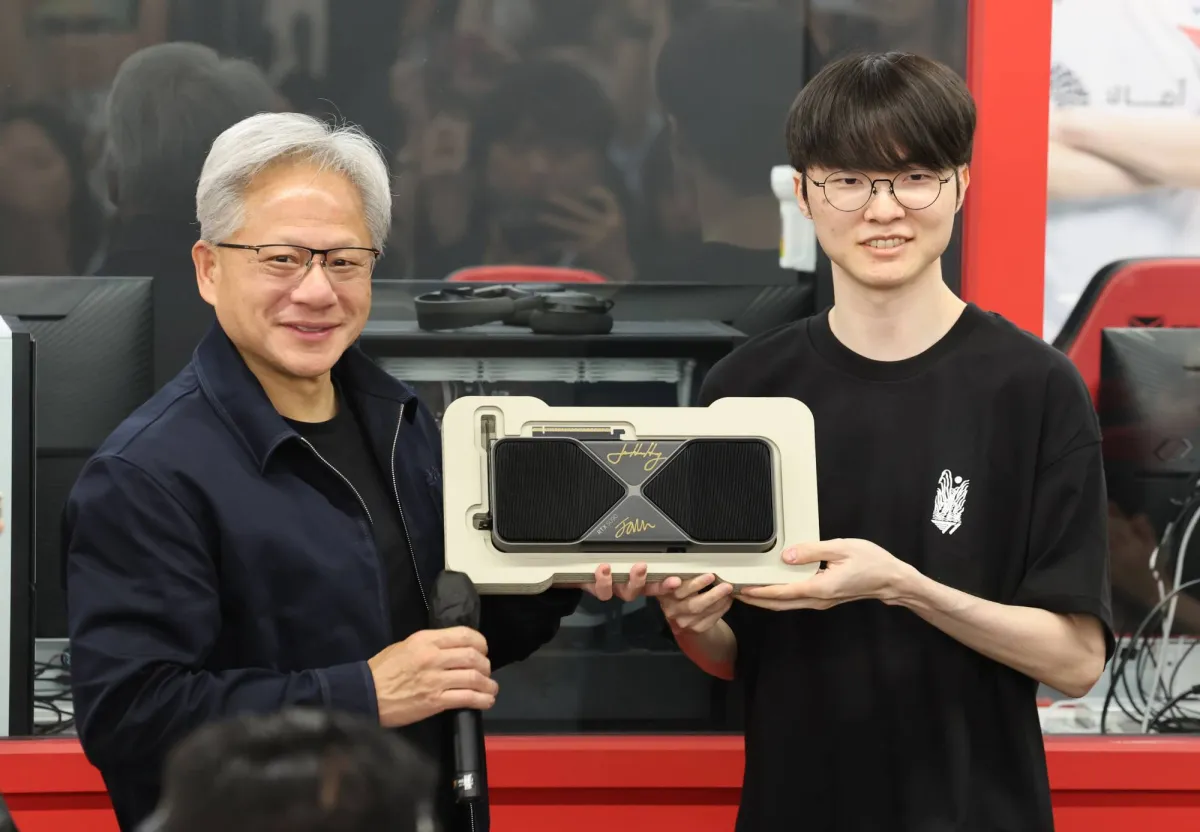
Jensen Huang, CEO of American technology giant Nvidia, has announced that the robotics sector will become the "next major industry" in South Korea, signaling a strategic shift for the company toward industrial artificial intelligence applications beyond traditional semiconductor manufacturing.
Huang made these remarks upon arriving at Gimpo International Airport from Taiwan, marking his second visit to Seoul within just seven months. This frequency reflects the magnitude of mutual ambitions between the American tech giant and South Korea's manufacturing industries, which are racing to align themselves with the artificial intelligence revolution.
Visit Details and High-Level Meetings
Speaking to reporters, Huang described South Korea as a "global industrial hub" where Nvidia's robotics and Physical AI technologies can be deployed. He emphasized that the country hosts the world's largest chipmakers, electronics manufacturers, automakers, and shipbuilders, making it a fertile environment for testing these advanced technologies.
The Nvidia CEO revealed a packed schedule of meetings with executives from Korean industrial giants, including Samsung Electronics, SK Hynix (the world's largest producers of memory semiconductors), Hyundai Motor, LG, and digital powerhouse Naver.
Huang believes semiconductor manufacturing will become increasingly reliant on robotics and AI in the near future, stating that this transformation "opens up tremendous partnership opportunities" with Korean companies that control approximately 70% of the global market for AI chip memory.
Strategic Context and Background
These developments come as part of Nvidia's efforts to expand its geographic and technical footprint. Huang announced that his company has already begun the hiring process for its new research center in South Korea, confirming that the official launch will occur once sufficient specialized personnel are onboarded.
Technology analysts view Nvidia's bet on South Korea as strategic rather than arbitrary. The country possesses an integrated industrial infrastructure combining mechatronics (mechanical and electronic engineering) with artificial intelligence, enabling the integration of these technologies to produce highly advanced robots capable of operating in complex industrial environments.
Together, Samsung and SK Hynix control roughly 70% of memory supplies used in AI chips globally, giving South Korea a strategic foothold in the global AI ecosystem, which increasingly requires massive computing capabilities.
Implications for the Technology Industry
Huang's announcement represents a qualitative shift in Nvidia's strategy, which built its reputation on graphics cards and AI processing units, toward robotics and intelligent automation based on "Physical AI"—a branch combining software algorithms with physical interaction with the surrounding environment.
Digital economy experts believe this move could fundamentally transform global supply chains, as South Korea seeks to reduce its reliance on technology imports and enhance its indigenous capabilities in industrial AI, particularly amid geopolitical tensions affecting the flow of advanced technologies.
When jokingly asked about gifts he brought to Korea, Huang replied: "Did I bring any gifts? I brought a lot of business to Korea," referring to expected investments and job opportunities, adding that the company has "some surprises" to be revealed later.
Regional Impact on Arab World and Developing Nations
These developments hold particular significance for the Arab world, which seeks to diversify its digital economies, as South Korea serves as a model for transformation from a developing nation to an industrial power driving innovation. The collaboration between Nvidia and Korean industry opens new horizons for Arab countries seeking to import advanced robotics technologies to develop their industrial and logistics sectors.
This shift also serves as a reminder of the urgent need to accelerate digital transformation plans in the Arab region, particularly in industrial AI and automation, to avoid widening the technological competitiveness gap with global industrial centers. These new technologies may open opportunities for joint investments between Arab and Korean companies in renewable energy, smart cities, and advanced logistics services.
As the technology race continues among major powers, the coming phase appears set to witness unprecedented industrial alliances, making robotics a common language between different cultures and economies, in a landscape that redraws the map of global economic power.