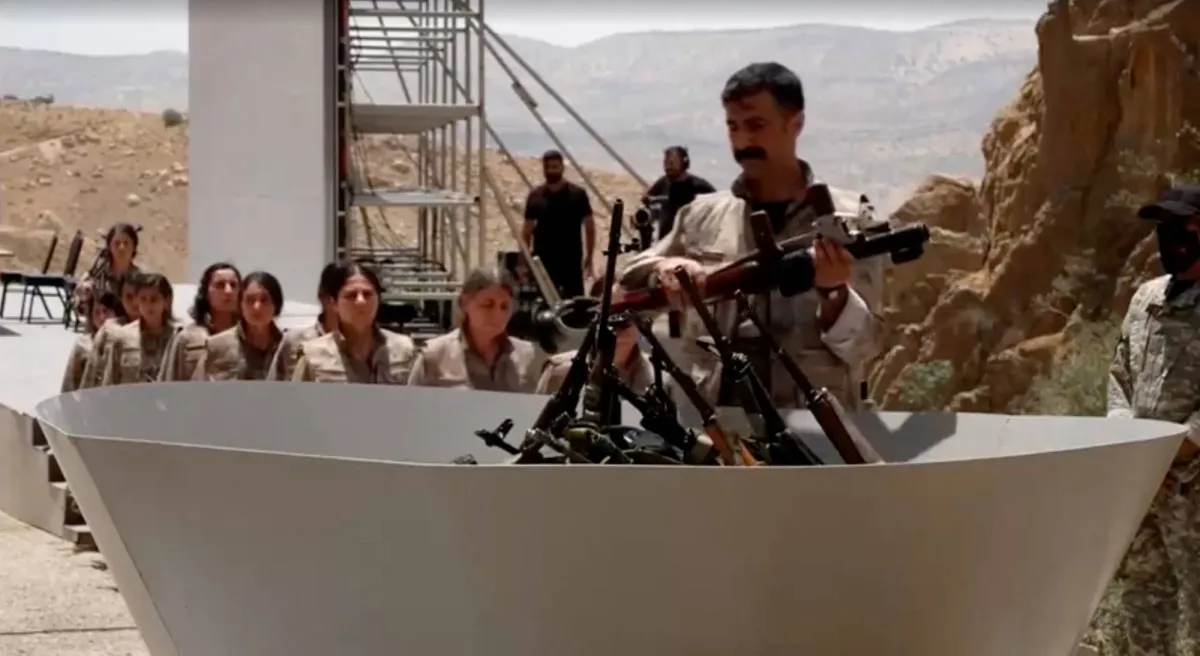
Abdullah Ocalan, the leader of the Kurdistan Workers' Party, has issued a renewed call for Kurds to embrace democracy as a means to address their internal problems and engage in negotiations with the countries they reside in. This message was conveyed during the "Northern Kurds Discuss National Unity" conference held in Diyarbakir, where he stressed the necessity of rejecting violence and arms.
In his message, part of a "Call for Peace and Democratic Society" he launched in February 2025, Ocalan urged the party to disband and lay down its weapons. He emphasized the importance of building the Kurdish community on democratic foundations, not only in external relations but also in internal dynamics.
Details of the Event
Ocalan pointed out that "democratic unity is a historical necessity," considering that holding a comprehensive conference for democratic unity is an urgent task to demonstrate the common will. He also asserted that the survival of any community depends on its ability to adapt to the realities of the era, and that no social structure can endure without change and evolution.
Furthermore, Ocalan noted that Kurds have been deprived of the opportunity to undergo this transformation due to years of denial and repression policies. He highlighted that the fundamental issue facing the Kurdish community today is how to transition into a modern democratic society, indicating that the sustainability of the Kurds relies on their ability to assert their will in political, economic, and educational spheres.
Background & Context
Ocalan's call comes at a sensitive time, as the "Democracy and Equality for Peoples" party seeks to push the Turkish government towards taking steps that accelerate the peace process. Turkish President Recep Tayyip Erdogan has confirmed that the process is progressing positively, while the Turkish Parliament Speaker warned that the Kurdistan Workers' Party's failure to disarm could hinder the advancement of the process.
In this context, Ocalan indicated that the next phase requires rebuilding the Kurdish community on a democratic basis, warning of obstacles that may impede this path, such as the tribal system based on clans, which fragments the community and weakens its social structure.
Impact & Consequences
Ocalan's call to adopt democracy could significantly influence the future of Kurds in Turkey and the region. Embracing this approach may contribute to improving relations with the Turkish government and enhance opportunities for dialogue and understanding. Additionally, strengthening democratic principles could aid in establishing robust political and social institutions, contributing to the stability of the Kurdish community.
However, challenges remain, as achieving democratic unity requires overcoming internal conflicts and creating a social climate based on mutual respect. This necessitates substantial efforts from all parties involved.
Regional Significance
Ocalan's call for democracy holds particular significance for the Arab region, where many communities suffer from internal conflicts and political challenges. Promoting democracy as an alternative to violence could serve as a model for other areas in the Middle East, where citizens strive to achieve their rights and aspirations.
In conclusion, Ocalan's appeal stands as a call for positive change, as it could contribute to building a more stable and hopeful future for both the Kurds and the region as a whole.