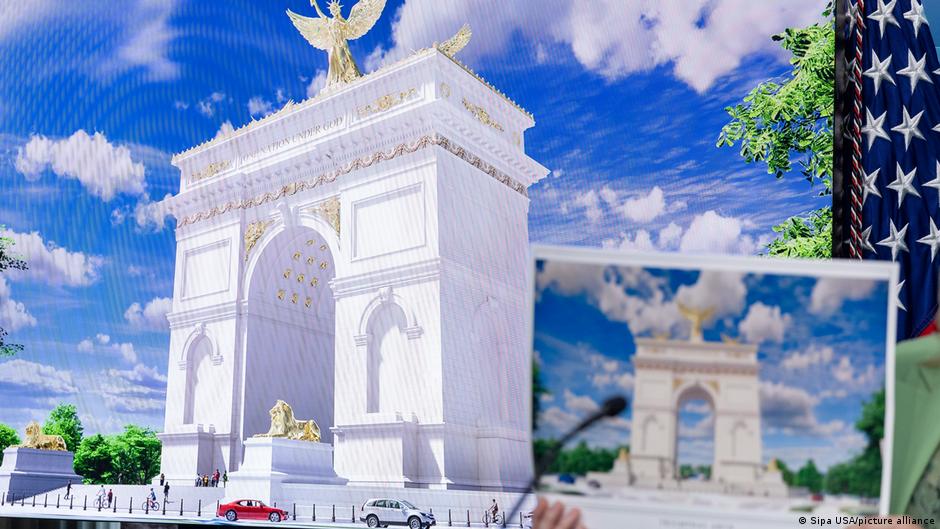
Questions are increasingly being raised about the concept of 'political pride projects' in light of U.S. President Donald Trump's proposals for a series of costly architectural projects in Washington, D.C. These proposals include the construction of an arch at a cost of up to $100 million, a ballroom in the White House costing $1 billion, and the redesign of the Lincoln Memorial reflecting a budget of $13 million.
These projects have sparked debate over whether they serve the public interest or reflect personal ambitions of the president. Reports suggest that these initiatives could serve as tools to enhance Trump's political image, raising questions about the intentions of leaders in executing such projects.
Details of the Event
The concept of a 'pride project' is complex and cannot be classified definitively. Esraa Aqan, an architecture professor at Cornell University, states that the intention behind a project is what distinguishes between public service and political pride. She adds that projects focusing on size and grandeur rather than meeting community needs may be considered pride projects.
Historically, rulers have utilized monumental architecture to demonstrate power and legitimacy. For instance, totalitarian regimes in the 20th century in Germany, Italy, and the Soviet Union employed massive architectural forms to signify their strength both domestically and internationally. Additionally, Adolf Hitler sought to construct monumental projects like the Chancellery in Berlin.
Background & Context
The history of political architecture is filled with examples of using grand projects to affirm national identity. In the 17th century, Louis XIV expanded the Palace of Versailles to become the center of political life in France. The aim was to enhance his authority and clarify his role in governance to all.
However, Aqan warns against comparing modern projects with ancient landmarks like the pyramids, as these monuments belong to entirely different ideological and economic systems. She emphasizes that contemporary leaders often exploit architecture from previous eras to legitimize their projects driven by personal ambitions.
Impact & Consequences
Modern architecture is considered a tool used by leaders to shape political identity and legacy. Sara Moser, a geography professor at McGill University, notes that city building is a quintessential political project, as cities reflect a political vision or personal legacy. Countries outside the West have utilized new cities to market themselves or signal a new political era.
For example, Masdar City in Abu Dhabi is seen as a model for a carbon-neutral and waste-free city, aiding in rebranding the Emirati capital as a modern and advanced city. Meanwhile, the capital Naypyidaw in Myanmar illustrates how religious symbols in architecture can present the state as rooted in a specific religious identity.
Regional Significance
The importance of these projects is evident in the Arab world, where many leaders seek to build landmarks that reflect their power and aspirations. For instance, projects like NEOM in Saudi Arabia demonstrate how architecture can embody an ambitious political vision. However, these projects should be viewed critically, as they may be used as a means to divert resources away from the basic needs of citizens.
In conclusion, political pride projects remain a contentious topic, where personal ambitions intersect with the public good. It is crucial to monitor how these projects evolve and their impact on communities.