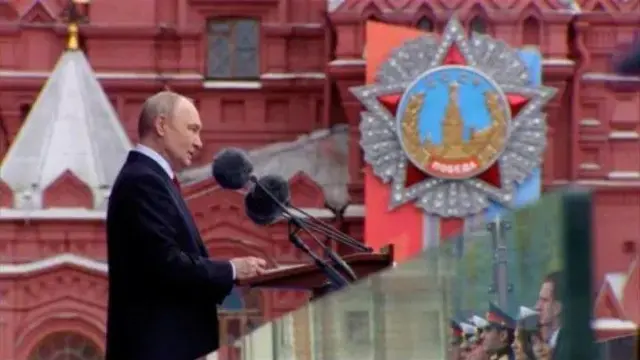
During the Victory Day celebrations, which are considered an important national occasion in Russia, President Vladimir Putin criticized the North Atlantic Treaty Organization (NATO), pointing to the increasing tensions between Russia and Western nations. These remarks come at a time when relations between Russia and the West have noticeably deteriorated, with NATO viewed as a threat to Russian national security.
In his speech, Putin emphasized the significance of Victory Day as a symbol of triumph over fascism in World War II, asserting that Russia will always be prepared to defend its interests. The Russian president used this occasion to showcase military strength, displaying a range of modern weapons and military equipment, reflecting the power of the Russian army and its capability to respond to challenges.
Event Details
The Victory Day celebrations in Russia are an annual tradition held on May 9, commemorating the Russians' victory over Nazism. This year, the celebrations were organized on a limited scale, with a reduced number of participants in the military parade due to the current geopolitical circumstances.
The military parade featured a display of tanks and aircraft, alongside units from the armed forces. The celebrations were attended by several military and political leaders who expressed their support for Putin's policies in facing external challenges.
Background & Context
Since Putin came to power, the Victory Day celebrations have become a propaganda tool used to showcase Russian military might. In recent years, tensions between Russia and NATO have intensified, especially following Russia's annexation of Crimea in 2014, which led to economic sanctions imposed on Moscow.
These celebrations provide an opportunity for Putin to reaffirm his strong position before the Russian people, demonstrating that Russia remains a great power capable of facing challenges. Additionally, this occasion is used to bolster national spirit among Russian citizens amid difficult economic and political conditions.
Impact & Consequences
Putin's remarks during the celebrations may escalate tensions with the West, as they are perceived as a direct challenge to NATO. This escalation could contribute to increased military readiness among NATO member states, potentially leading to a new arms race in the region.
Furthermore, these statements could impact economic relations between Russia and Western countries, possibly resulting in further sanctions against Moscow, which would increase economic pressures on the Russian populace.
Regional Significance
Russian-Arab relations are significant, as Russia seeks to enhance its influence in the Middle East. The tensions between Russia and NATO may affect Arab positions towards Russia, especially given the economic and political challenges faced by Arab nations.
Moreover, the escalation in relations between Russia and the West could impact regional security, potentially increasing tensions in conflict areas such as Syria and Libya, complicating peace and stability efforts in the region.
In conclusion, the Victory Day celebrations remain an opportunity for Putin to assert his power, but they also reflect the challenges facing Russia amid strained relations with the West. It is crucial to monitor upcoming developments and their impact on the international stage.