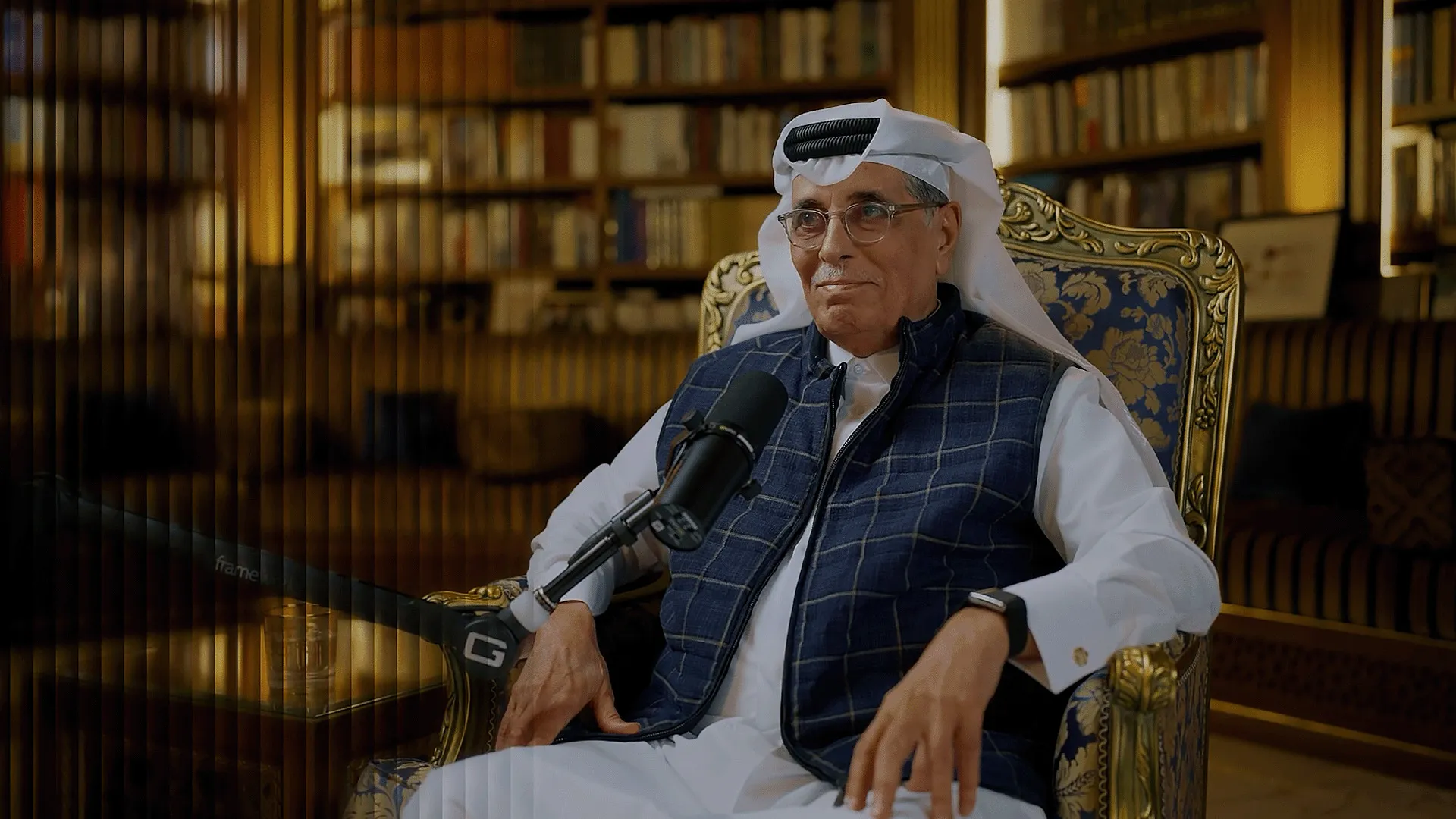
Dr. Hamad bin Abdulaziz Al-Kawari, Minister of State and President of the Qatar National Library, detailed significant milestones from the beginnings of Qatari diplomacy, highlighting his experience as a young diplomat in Arab and international capitals during periods marked by wars and major political transformations. Al-Kawari affirmed that managing crises behind the scenes requires a deep understanding of balances and personal relationships.
In an episode of the podcast "On the Edge," Al-Kawari spoke about his childhood in Al-Ghariya village in northern Qatar and his early beginnings in diplomatic work, leading to pivotal moments in Beirut, Damascus, Paris, and Washington, which shaped his political and professional awareness. He explained that his professional life began early with Qatar's independence, where he took on diplomatic responsibilities in his early twenties, which forced him to engage with political figures older and more experienced than himself.
Event Details
Al-Kawari reminisced about his childhood in Al-Ghariya, noting that a recent visit to the village brought back memories he thought he had forgotten, from the old houses to the struggles of residents in fetching water. He considered that environment as part of his generation's consciousness and human experience.
His first diplomatic station was in Beirut, where he served as Chargé d'Affaires after being nominated to work at the Qatari embassy in Tehran. He explained that the Lebanese capital provided him with the opportunity for direct engagement with complex Arab political files, at a time when Qatari diplomacy was gradually taking shape.
His work in Beirut led him to follow the Syrian file through repeated visits to Damascus and meetings with Syrian officials, including Abdel Halim Khaddam, before he was later appointed as Qatar's ambassador to Syria after the October War. He noted that his presence in Damascus coincided with the early years of Hafez al-Assad's rule, a period characterized by a widespread Arab nationalist sentiment following the war.
Background & Context
Al-Kawari described his experience in Syria as one of the most significant phases of his life, both professionally and socially. He emphasized that the Syrian community embraced him and his family significantly, and he formed close relationships with political and academic figures during that time.
Al-Kawari later moved to Paris as Qatar's ambassador, explaining that this step came unexpectedly, as the French capital provided him with a different dimension in diplomatic work, through openness to European political and cultural circles.
Afterward, he transitioned to New York as a permanent representative to the United Nations, where this role introduced him to the world of multilateral diplomacy. He participated in monitoring political, economic, and legal files within the corridors of the international organization, noting that he was preparing his doctoral thesis on decision-making in the Security Council during the Iran-Iraq War.
Impact & Consequences
This phase coincided with his efforts to connect his academic work with his practical experience at the UN. Speaking about his final station in Washington, Al-Kawari mentioned that he arrived in the U.S. capital during a period when relations between the two countries were tense due to congressional decisions to freeze some aspects of cooperation with Doha.
He clarified that his mission seemed complicated at first; however, Iraq's invasion of Kuwait changed the nature of regional and international relations, opening the door to a new phase of cooperation between Qatar and the United States. Al-Kawari revealed the behind-the-scenes communications that preceded former U.S. Secretary of Defense Dick Cheney's visit to Doha, where Qatar insisted on ending the political freeze before receiving the American official.
Regional Significance
These developments contributed to establishing a new phase in Qatari-American relations, which later evolved at political and military levels, amid the transformations witnessed in the region following the invasion of Kuwait. In evaluating that phase, Al-Kawari considered that former Iraqi President Saddam Hussein made a grave strategic error by occupying Kuwait and then failing to withdraw despite international warnings.
Al-Kawari concluded by emphasizing that diplomatic work is not solely based on formal relations but also relies on understanding history, building trust, and the ability to read transformations before they occur. He believed that these elements were the foundation of his experience in managing files and crises.