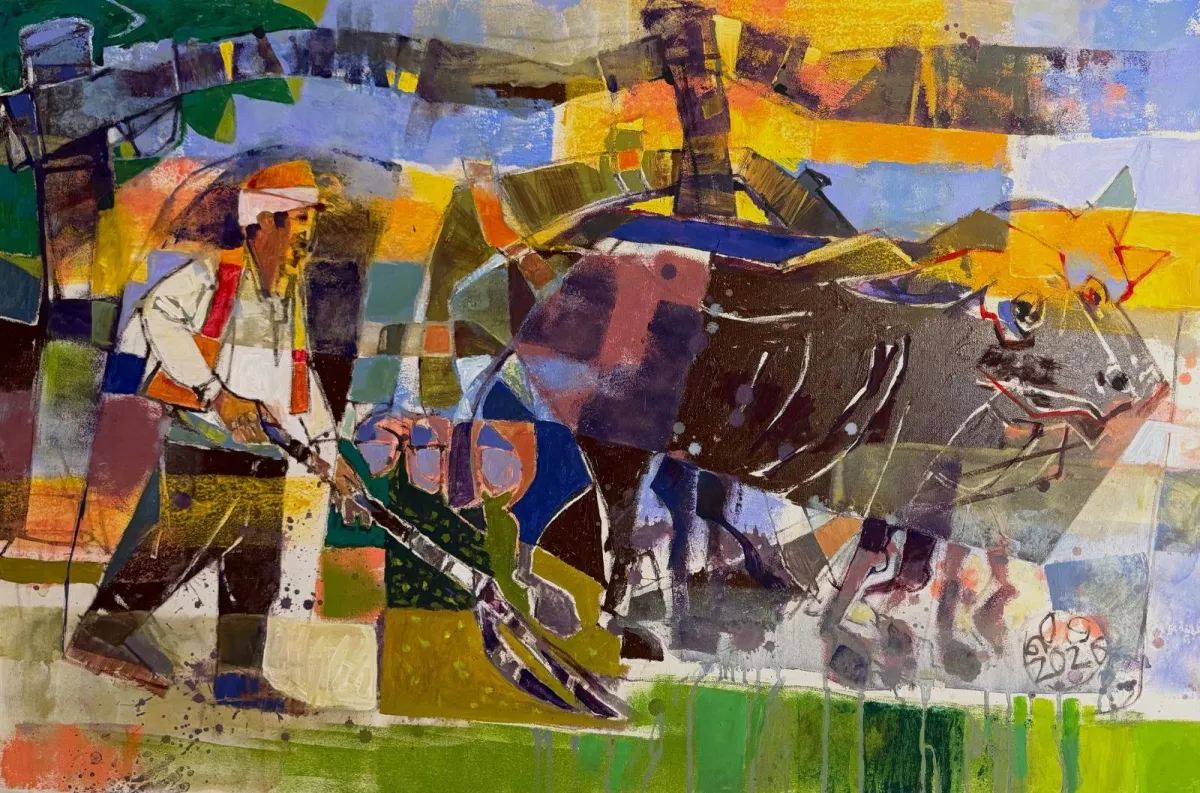
Egyptian visual artist Asem Abdel Fattah presents his innovative exhibition "Nile Squares" at Picasso East Gallery, running until April 13. The exhibition creatively merges heritage with modernity, offering a fresh perspective on Egyptian identity through what he calls "the engineering of emotions." Abdel Fattah's work aims to deconstruct everyday life forms and reconstruct them into an artistic framework that provides a new, dynamic reading of Egyptian heritage.
Through his artworks, Abdel Fattah explores how the spaces we inhabit shape our identities, inviting the audience to reclaim memories of the past to envision a vibrant future. The past does not appear in the exhibition's paintings as static memories; instead, it manifests as a renewed life composed of color and geometric units that interact rhythmically, creating a dialogue between heritage and modernity.
Event Details
Abdel Fattah emphasizes his philosophy of choosing the square shape as a fundamental element in his works, viewing it as a symbol of order and stability. He states, "This theme is not a formal decision but an expressive vision that allows for repetition and transformation." He likens this shape to the land tilled by a farmer or the wall that embraces the echoes of music, reflecting the depth of the idea he seeks to embody.
Through geometric construction, the artist redefines the vocabulary of daily life, from the buffalo representing the rural backbone to the musicians who pulse life into the scene, the palm trees guarding the banks of the Nile, and the bustling markets filled with the scents of spices and ancient perfumes. Each square and color in his paintings represents a part of a rich human experience that speaks of Egypt and its profound spirit.
Background & Context
Asem Abdel Fattah is considered one of the prominent painters in Egypt, having earned a Bachelor's degree in Fine Arts in 1982, a Master's degree in 1989, and a PhD in Fine Arts in 1993. He has been active in the artistic movement since 1979 and was selected in 2003 as an expert for the UNESCO Digital Arts Project, reflecting his esteemed position in the art scene.
His works are characterized by a focus on embodying the world of the simple and marginalized, whom he considers "the living memory of the spirit of the place." His paintings reflect the details of popular life in alleys and villages, capturing the sounds, scents, and human relationships, making them relatable and touching to people's emotions.
Impact & Consequences
Abdel Fattah's works transcend mere artistic representation, as he presents what he calls "the engineering of emotions," where feelings of affection, connection, hope, and nostalgia manifest in his works, bridging the past and the anticipated future. He emphasizes the need to contemplate the elements, colors, and light within the structural units, forming a new awareness of the world to which the painting belongs.
His works also feature authentic Egyptian materials such as kheima fabric, gold leaf, and popular decorations, giving the artworks a local character rooted in heritage. He prefers to use a vibrant color palette that suggests optimism and hope, evoking wonder through the embodiment of a different world with its unique composition, proportions, colors, and shadows.
Regional Significance
The "Nile Squares" exhibition represents a model of contemporary art that draws inspiration from heritage and reinterprets it in a new style, showcasing art's ability to transcend temporal and spatial boundaries. Amid the challenges facing cultural identity in the Arab world, this exhibition stands as a step towards enhancing pride in heritage and rediscovering it through a contemporary lens.
In conclusion, art remains a powerful means of expressing identity and belonging. Abdel Fattah's exhibition reflects the deep spirit of Egypt and revives heritage in an innovative style, contributing to the enhancement of culture and art in the region.