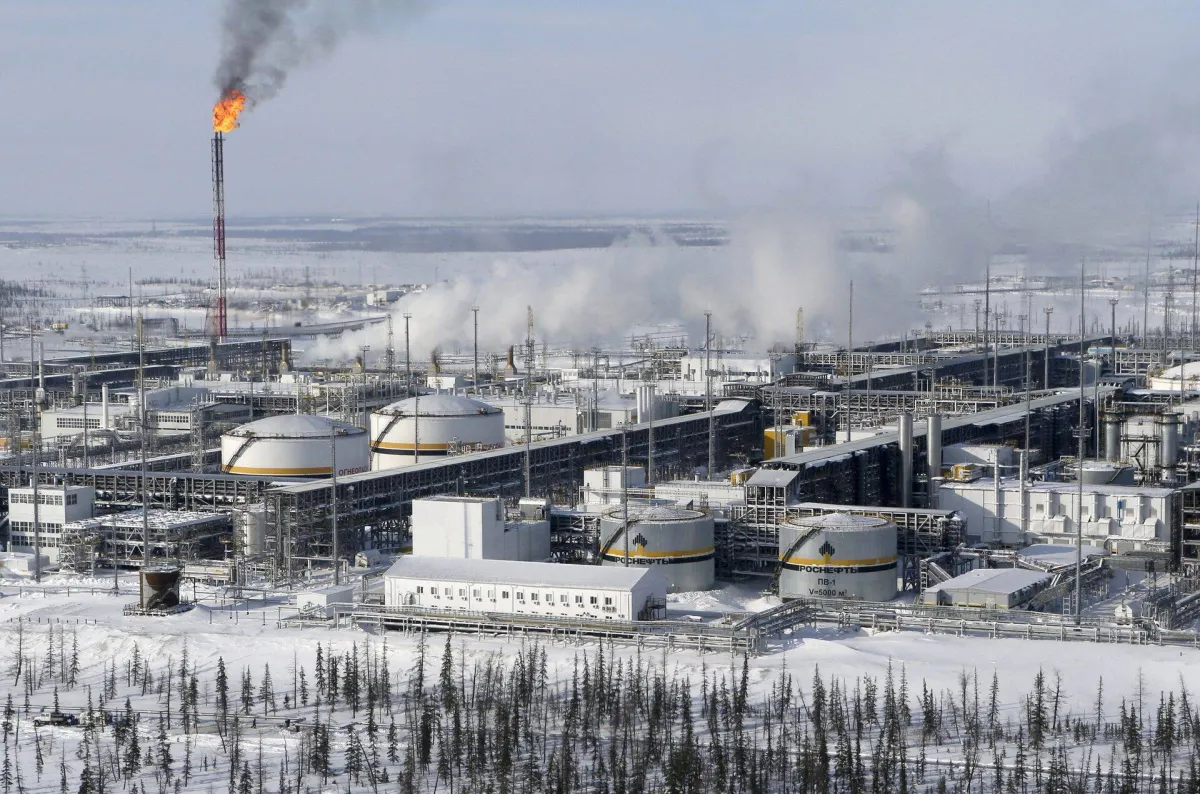
Russian oil and gas revenues experienced a sharp decline of 20.7% month-on-month in May, amounting to 678.9 billion rubles, which is equivalent to $9.26 billion, according to data from the Russian Ministry of Finance.
In April, revenues from oil and gas had reached 855.6 billion rubles, reflecting a significant drop in earnings. This decline comes at a time when Russia is grappling with the consequences of the Ukrainian war and the Western sanctions imposed on it.
Details of the Decline
Despite the revenue drop, reports indicate that the average daily natural gas supplies provided by Russian company Gazprom to Europe via the TurkStream pipeline increased to 47.4 million cubic meters in May, marking a 3% rise compared to last year. Turkey remains the only remaining transit route for Russian gas to Europe after Ukraine decided not to extend its five-year agreement with Moscow.
In May, the total Russian gas supplies to Europe reached 1.47 billion cubic meters, compared to 1.43 billion cubic meters in May 2022. Additionally, supplies during the first five months of the year increased by 6.4%, reaching 7.76 billion cubic meters on a year-over-year basis.
Background & Context
Since the beginning of 2023, Gazprom has not published its monthly statistics due to the ongoing Russia-Ukraine war, adding to the uncertainty of the situation. Last year, the company's gas exports to Europe fell by 44%, totaling 18 billion cubic meters, marking the lowest level since the mid-1970s.
Russian gas exports through pipelines to Europe peaked at around 180 billion cubic meters annually between 2018 and 2019, reflecting a significant shift in the European market.
Impact & Consequences
The decline in Russian oil and gas revenues is indicative of the negative impacts of Western sanctions and geopolitical tensions. Furthermore, the drop in revenues could affect the Russian economy as a whole, increasing pressure on the Russian government.
Some reports suggest that the continuation of these trends may lead to further economic challenges for Russia, especially with the growing reliance on gas supplies to Europe under the current circumstances.
Regional Significance
Arab countries are indirectly affected by fluctuations in global oil and gas prices, as these resources are essential for their economies. The decline in Russian oil revenues may lead to an increased demand for Arab oil, potentially contributing to price stabilization in global markets.
At the same time, Arab nations must be prepared to face any fluctuations that may arise from geopolitical situations, necessitating flexible strategies to adapt to market changes.