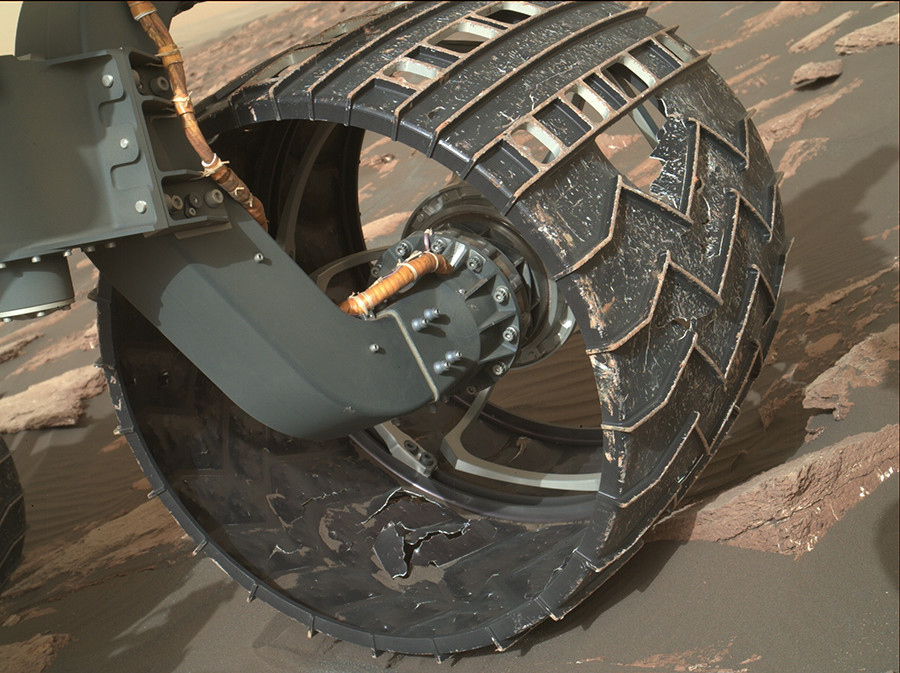
NASA's Curiosity rover is encountering a serious issue with severe wear on its wheels. Images taken by the camera mounted on the rover's robotic arm reveal that the wheels are suffering from significant damage, raising concerns about the rover's ability to continue its exploratory mission on the surface of Mars.
The images were captured on March 23 (Martian day 4844), revealing the extent of the damage caused by sharp rocks on the Martian surface to the rover's wheels. Although Curiosity is still operating efficiently after nearly 14 years since its landing on August 6, 2012, the condition of the wheels is gradually deteriorating, leading to questions about the future of the mission.
Details of the Incident
Recent images show that parts of the sides of the wheels, made of aluminum with a thickness of 0.75 millimeters, have completely collapsed. Signs of wear began to appear just 14 months after landing, due to sharp rocks puncturing the metal tires. Nevertheless, the rover continues to operate thanks to modifications made by NASA to its mobility system.
In response, NASA has formed a specialized team to address this issue, adjusting the speed of each wheel according to the nature of the terrain, which has reduced pressure on the front wheels by 20%. The driving paths have also been changed to softer areas, and at times the rover is moved backward to minimize damage. There is also a plan to use a sharp rock on Mars to remove damaged parts of the wheel when necessary.
Background & Context
The Curiosity rover is considered one of the most important missions for exploring Mars, designed to study the potential for microbial life on the red planet, as well as to understand Mars' climate and geological composition. The mission was launched on November 26, 2011, and the rover successfully landed in Gale Crater near the Martian equator, an area rich in geological features.
Curiosity carries an advanced suite of scientific instruments to analyze rocks and soil, and it has already discovered evidence suggesting that Mars once had a suitable environment for life, such as the presence of liquid water and essential chemical elements. The rover relies on nuclear power, using a radioisotope thermoelectric generator (RTG) to generate electricity, allowing it to operate day and night and through all seasons.
Impact & Consequences
If the damage to the wheels continues, scientists may face significant challenges in completing their research mission. Curiosity is a symbol of scientific and technological advancement, and any obstacles it encounters could impact our understanding of Mars. The success of this mission may also influence plans for future missions to the red planet.
These challenges are part of the risks faced by space missions, as exploring other planets requires constant adaptation to harsh environmental conditions. NASA's quick and innovative response may reflect the agency's ability to handle crises, enhancing its reputation in the field of space exploration.
Regional Significance
Space exploration missions, such as Curiosity, serve as an inspiration for many Arab countries seeking to develop their space programs. The challenges faced by this rover may encourage Arab nations to invest in research and development in space and technology, thereby enhancing their scientific and technological capabilities.
In conclusion, Curiosity remains a symbol of innovation and challenge. As NASA continues its efforts to overcome difficulties, hope remains for achieving further discoveries that could change our understanding of Mars.