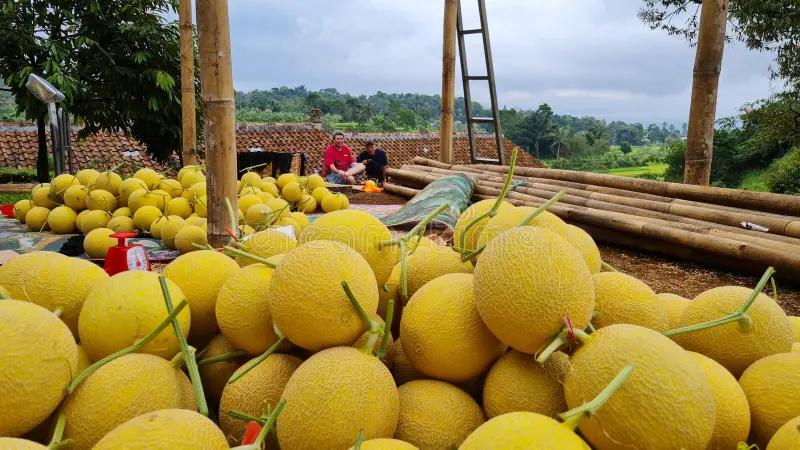
On Monday, the East Jakarta area witnessed a significant event in urban agriculture, with the harvest of 34 watermelons of the Enthanon variety, totaling 84 kilograms. Esi Firansi Mongiran, head of the Family Empowerment Team in East Jakarta, confirmed that this type of watermelon is distinguished by its high market value.
The harvest took place at the "Farming Geber Tabor" area, utilizing an agricultural space of 1,296 square meters. Modern greenhouses were employed, supported by the Corporate Social Responsibility program of DKI Bank, reflecting a shift towards sustainable agriculture.
Event Details
Esi explained that Enthanon watermelons are of excellent quality in terms of taste and appearance, with a single fruit potentially priced at around 100,000 Indonesian Rupiah. She noted that the success of this harvest reflects the ability of urban agriculture to meet community needs, as well as its potential to become a new source of local economy.
In addition to the Enthanon watermelons, a simultaneous harvest was conducted at 32 other locations in the Makassar area, yielding approximately 341 kilograms of vegetables and 90 kilograms of fruits. Esi emphasized that crop diversity is a key factor in developing urban agriculture in East Jakarta.
Background & Context
The Jakarta provincial government aims to enhance food security through the development of urban agriculture, organizing harvests at 807 locations across the capital. East Jakarta was the most active, with harvests conducted at 414 locations, followed by South Jakarta with 177 locations, North Jakarta with 94 locations, West Jakarta with 60 locations, Central Jakarta with 58 locations, and the Thousand Islands with 4 locations.
Urban agriculture in Indonesia is part of a larger strategy aimed at improving food security and promoting sustainability. These initiatives represent a significant step towards achieving food self-sufficiency amid environmental and economic challenges.
Impact & Consequences
The success of the Enthanon watermelon harvest serves as a model for effectively utilizing urban spaces. As urban populations grow, urban agriculture becomes a potential solution to food shortages. Additionally, the use of modern greenhouses enhances production quality and increases economic returns for farmers.
This experience demonstrates that urban agriculture can play a crucial role in improving living standards in urban communities, providing new job opportunities and promoting environmental sustainability.
Regional Significance
The urban agriculture experience in Indonesia serves as a model that Arab countries can benefit from, especially in light of food security challenges. Arab nations facing agricultural resource shortages can draw inspiration from these initiatives to develop similar strategies that enhance local production.
In conclusion, the harvest of Enthanon watermelons in East Jakarta is evidence of the potential to achieve food security through urban agriculture, opening doors for further innovations in this field.