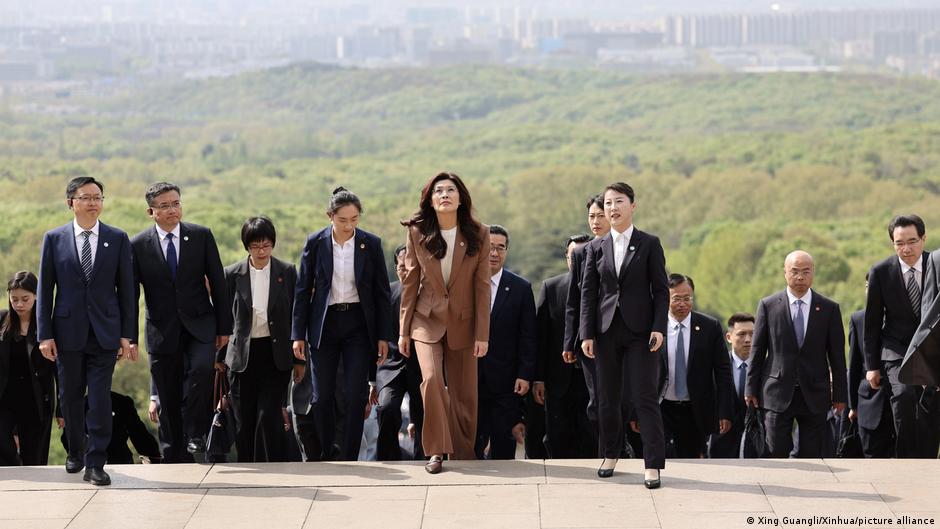
In a historic move, Taiwanese Kuomintang leader, Cheng Li-wen, visited the Chinese city of Nanjing, where she called for enhancing relations with the Chinese government. This visit marks the first of its kind by a party leader to China in a decade, reflecting the party's desire to improve ties amid escalating tensions with Taiwan's ruling Democratic Progressive Party.
Cheng, who received an invitation from Chinese President Xi Jinping last March, hopes to meet him during her visit, although no official meeting has been announced yet. This visit carries symbolic weight, as Nanjing was the capital of the Kuomintang-led government before it retreated to Taiwan following the Chinese Civil War in 1949.
Details of the Visit
During her visit, Cheng paid homage at the shrine of Sun Yat-sen, the founder of the Kuomintang, who is considered a significant revolutionary figure in China's history. She noted that the party has made substantial achievements in transforming Taiwan into a democratic society, while also acknowledging the 38-year period of military rule.
In her statements, Cheng emphasized the importance of fostering peace across the Taiwan Strait, asserting that war is not an inevitable fate. She also called for collaborative efforts towards achieving unity and regional prosperity.
Background & Context
The roots of the division between China and Taiwan trace back to the Chinese Civil War, during which the Kuomintang fled to Taiwan after being defeated by the communists led by Mao Zedong. Since then, Beijing has regarded Taiwan as part of its territory, while Taiwan insists on its independence.
In recent years, relations between the two sides have significantly deteriorated, especially following the election of Taiwanese President Tsai Ing-wen from the Democratic Progressive Party in 2016, who has refused to acknowledge Beijing's demands. Since then, the region has witnessed a rise in military tensions, with China conducting large-scale military exercises around Taiwan.
Impact & Consequences
Cheng's visit comes at a critical juncture, as Beijing seeks to bolster its position in the region while Taiwan remains concerned about increasing military threats. The director of Taiwan's National Security Bureau noted that China is using military threats to create an atmosphere of fear and anxiety within Taiwanese society.
At the same time, a spokesperson for the Democratic Progressive Party criticized Cheng's visit, stating that the Kuomintang should cease obstructing the defense budget to promote stability across the strait. He affirmed that peace cannot be achieved through the appeasement of dictatorial regimes, but must be maintained through Taiwan's own strength.
Regional Significance
This visit is significant as it represents a potential shift in the dynamics between Taiwan and China, especially in light of the current tensions. It may influence regional stability and prompt neighboring countries to closely monitor developments.
In conclusion, Cheng's visit underscores the complexities of cross-strait relations and the ongoing quest for reconciliation amid rising tensions. The outcome of this visit could have lasting implications for the future of Taiwan-China relations.