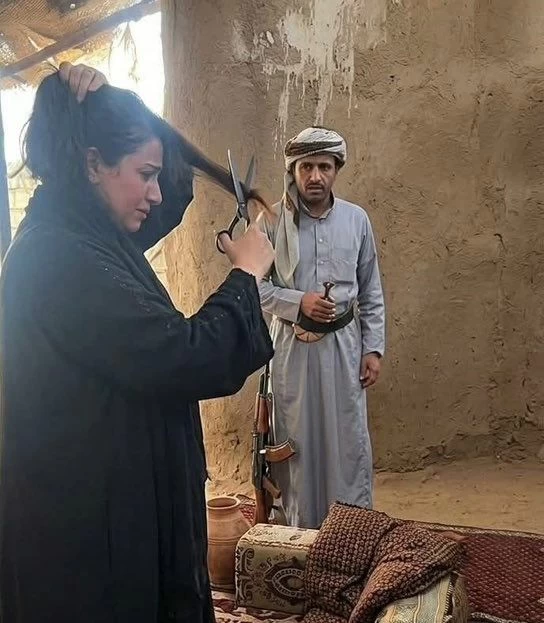
The debate surrounding the Iraqi woman 'Mira', who asserts she is the daughter of the late Iraqi President Saddam Hussein, continues to unfold, with unprecedented public and tribal engagement in Yemen. This surge coincides with extensive tribal movements aimed at rectifying her situation and reclaiming her properties and documents, which she claims have been seized.
While the narrative remains divisive between supporters and skeptics, public sympathy for her is growing, particularly in areas under Houthi control. The tribes of Al-Jawf have become involved in the case, transforming it from a mere story circulating on social media into a rapidly engaging tribal and social issue.
Details of the Event
On Saturday morning, a tribal meeting was held at the home of Sheikh Hamad bin Rashid bin Daghm in Al-Jawf province, attended by several sheikhs and members of the Dahm tribe. The meeting focused on discussing the next steps to support 'Mira' and demand the return of her rights, including her home, car, and personal documents that she claims were taken by Houthi leaders.
Informed sources confirmed that the meeting discussed peaceful, legal, and tribal avenues for action, with rising tribal enthusiasm for the cause. Participants expressed their commitment to continue efforts until what they described as 'lifting the injustice from her' is achieved.
Background & Context
Following the meeting, a tribal delegation traveled to Sana'a to meet Sheikh Naji Abdulaziz Al-Shaif, the Sheikh of Sheikhs of Bakil. Activists circulated images and clips from the meeting held at his home, where Sheikh bin Daghm spoke about 'Mira's' case, showcasing a braid of her hair that she cut in a previous appearance, a tribal gesture signifying a call for help and support.
Sheikh Hamad emphasized that supporting 'Mira' is a duty, regardless of the validity of her claim to be Saddam Hussein's daughter. An official meeting was also held at Al-Shaif's home to discuss mechanisms for peaceful and legal action to reclaim what 'Mira' describes as her stolen rights.
Impact & Consequences
Sheikh Hamad bin Rashid has appeared several times in recent hours, declaring his full support for 'Mira' and reaffirming his determination to restore her rights. He also directly accused leader Faris Manaa of seizing her properties and funds. This escalation comes less than 24 hours after 'Mira' appeared cutting her braid of hair in front of the tribal sheikh, a scene that sparked widespread reactions within Yemen and beyond.
In her latest appearance, 'Mira' returned via a new video, speaking with greater confidence and asserting that she is Saddam Hussein's daughter, indicating that she possesses a DNA test report proving her lineage. She also called on the daughters of the late Iraqi president to come forward and respond to her claims.
Regional Significance
Observers believe that the continued silence from Saddam Hussein's daughters may amplify the controversy surrounding the case, especially with 'Mira's' demand for a new DNA test with one of Saddam Hussein's daughters to definitively settle the matter. Sources confirmed that Sheikh Hamad bin Rashid is fully convinced of the validity of 'Mira's' narrative, both regarding her lineage and what she describes as the 'injustice' she has faced.
This tribal escalation reflects the social and political tensions in Yemen and highlights how tribes engage with personal issues that carry broader implications within the Yemeni context.