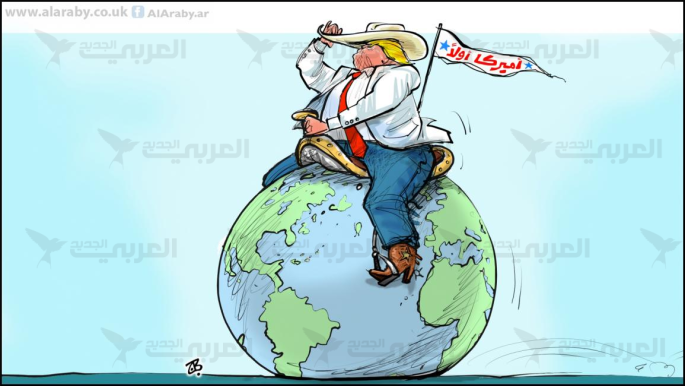
Former President Donald Trump redefined international relations in an unprecedented manner, viewing allies merely as parties to be coerced. This approach in his foreign policy led to a significant erosion of trust between the United States and its allies, adversely affecting American legitimacy on the global stage.
This policy is evident in many of Trump's stances, where relations with other countries were treated as financial transactions, leading to a noticeable decline in trust towards the United States. This new dynamic in international relations raises questions about the future of traditional alliances and how they will impact the global order.
Details of the Event
During his presidency, Trump employed a strategy based on pressure and coercion to achieve U.S. interests. He treated allied nations as adversaries, resulting in deteriorating relations with many traditional partners. For instance, negotiations with NATO were marked by tension, as Trump demanded that European countries increase their defense spending, threatening to reassess U.S. commitments to the alliance.
Moreover, U.S. relations with countries like Canada and Mexico experienced unprecedented tensions, as Trump imposed tariffs on imported goods, provoking angry reactions from those nations. This coercive financial approach was not limited to allied countries but also extended to others like China, where Trump took stringent trade actions that escalated economic tensions.
Background & Context
Historically, the United States was viewed as the superpower promoting democratic values and human rights, working to build strategic alliances with other nations. However, with Trump's rise to power, this model began to change radically. Trump's policies shifted from collaboration to confrontation, fundamentally altering the landscape of international relations.
This shift has significant implications, as it challenges the established norms of diplomacy and cooperation that have characterized U.S. foreign policy for decades. The unpredictability of Trump's approach has left many allies uncertain about the reliability of the United States as a partner.
Impact & Consequences
The consequences of Trump's foreign policy are profound, leading to a fragmentation of traditional alliances and the emergence of new power dynamics. Countries that once relied on U.S. support are now reconsidering their strategies and seeking to assert greater independence in their foreign relations.
Additionally, this shift has allowed other global powers, such as China and Russia, to increase their influence, filling the void left by a more isolationist United States. The long-term effects of these changes could reshape the global order, leading to a more multipolar world where U.S. dominance is challenged.
Regional Significance
In the Middle East, Trump's policies have prompted Arab nations to reassess their relationships with the United States, as they seek to navigate a complex geopolitical landscape. The increased independence of Arab states in decision-making reflects a broader trend of nations seeking to diversify their partnerships beyond traditional alliances.
As these dynamics unfold, the implications for U.S. foreign policy and its ability to influence regional outcomes will be critical. The evolving relationships may redefine the balance of power in the region and challenge U.S. interests.
In conclusion, Trump's approach to international relations has fundamentally altered the landscape of global diplomacy. The ramifications of these changes will likely resonate for years to come, as nations adapt to a new reality where traditional alliances are tested and redefined.