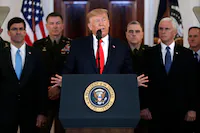
In a 20-minute address, President Donald Trump attempted to alleviate American fears over rising fuel prices but failed to provide a clear vision, increasing public anxiety. British media deemed the speech a lackluster effort amid Trump's declining popularity.
The British newspapers "i Paper" and "The Times" covered Trump's speech regarding the war with Iran, noting that it did not address the concerns of Americans worried about skyrocketing fuel prices. Writer Daniel Bates in "i Paper" described the speech as unconvincing, resembling a repetitive campaign rally speech.
Details of the Event
In his analysis, Bates pointed out that Trump's appearance was fatigued and his voice hoarse, reflecting his failure to deliver a clear vision regarding the war. He merely repeated claims about nearing military objectives, with comparisons that the writer described as "ridiculous" between this war and long conflicts such as World War II and the Vietnam War.
On the other hand, George Grylls in "The Times" highlighted the contradictions in Trump's statements, where he claimed that the war would end in two to three weeks while deploying thousands of additional soldiers and planning major military operations. This contradiction reflects the uncertainty faced by the U.S. administration amid Trump's declining popularity.
Background & Context
These developments come at a time when the U.S. administration is grappling with declining approval ratings, which have dropped to record lows of 33% in some polls. It is believed that this speech was an attempt by Suzy Wiles, the White House Chief of Staff, to bring Trump back into the spotlight ahead of the midterm elections.
The report also noted that the absence of a unified message in the speech reflects a deep division within the "MAGA" movement, between an isolationist faction represented by Tucker Carlson and Marjorie Taylor Greene, and the "neoconservatives" pushing for escalation.
Impact & Consequences
Regarding the economic situation, Americans were expecting genuine empathy for their struggles due to rising fuel prices, which have reached $4 per gallon. However, Trump ignored the global economic damage, merely describing the increase as "short-term," which drew ridicule from analysts.
Bates also conveyed analysts' mockery of Trump's idea that the Strait of Hormuz would "automatically" open once the war ended, describing this notion as pure fantasy. While Trump attempted to reassure voters that prices would drop quickly, some observers considered that the living pain of citizens is beginning to turn into a looming political threat for the Republican Party.
Regional Significance
The repercussions of Trump's speech on the Arab region manifest in the continuation of military and economic tensions. As economic crises escalate in the United States, these conditions may affect U.S. relations with Arab countries, especially those reliant on oil. Furthermore, the continuation of the war could increase instability in the region, adversely affecting regional security.
In conclusion, the consensus between the views of "i Paper" and "The Times" indicates that the U.S. administration is besieged by internal pressures, attempting to market an illusory victory at a time when citizens are drowning in economic crises that verbal promises can no longer resolve.