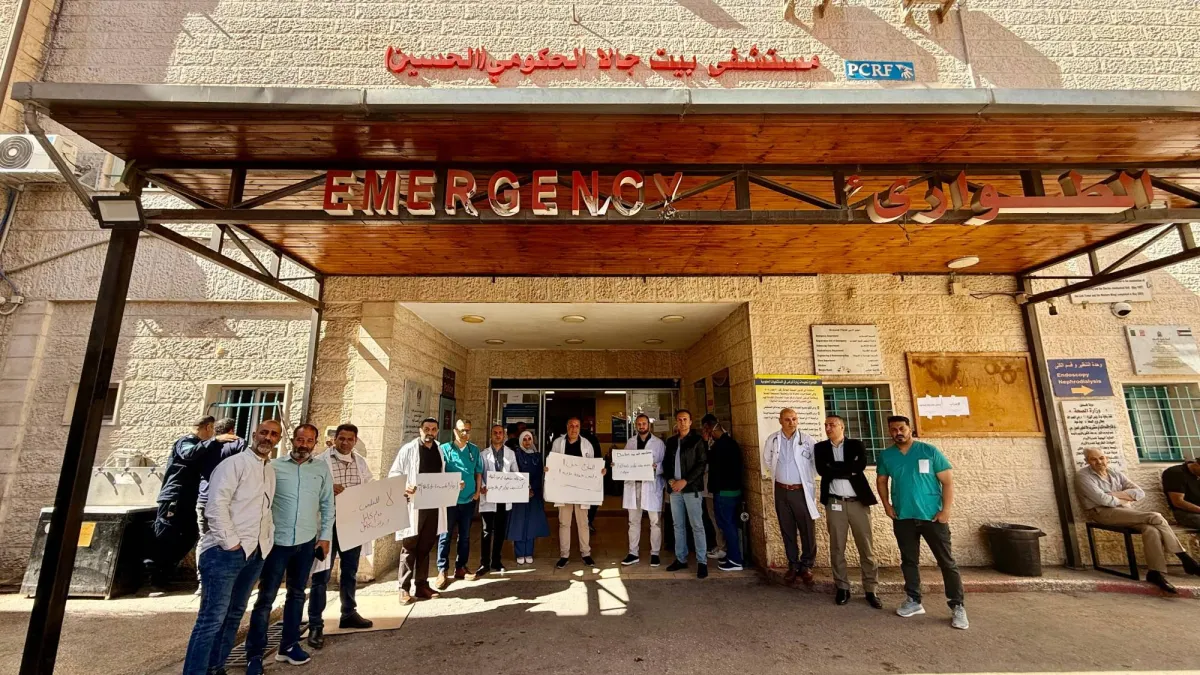
Union strikes are intensifying in Palestine as the doctors' union joins protests against the government, accused of stubbornness and favoritism. This situation threatens to paralyze essential services.
These strikes come at a time when the Palestinian Authority is suffering from a severe financial crisis that has worsened over the years, leading to a decline in living conditions and health services.
Details of the Event
The doctors' union announced a comprehensive strike, closing healthcare centers and hospitals, limiting services to life-saving procedures only. Hospitals have completely shut down, resulting in doctors gathering outside medical facilities holding banners demanding their rights and dignity.
In radio statements, the head of the doctors' union, Salah Al-Hishlamoun, emphasized that the government must take responsibility for the deterioration of the health situation, calling for its resignation if it cannot manage the country fairly.
Background & Context
The roots of the financial crisis trace back to Israel withholding tax revenues, with the Palestinian Authority estimating the withheld funds at over 14 billion shekels (approximately 4.5 billion US dollars). Since 2019, Israel has begun deducting a portion of tax revenues, negatively impacting the government's ability to pay salaries and provide essential services.
Prior to the doctors' union, the health professions union had announced a partial strike, indicating rising discontent among various professional groups. Simultaneously, the public employees' union called for a comprehensive strike, reflecting a growing anger towards the government.
Impact & Consequences
These strikes directly affect health, educational, and judicial services, as courts have ceased operations, resulting in paralysis in the judicial system. Doctors and nurses are facing increasing pressure due to shortages of medicines and medical resources.
Criticism of the government is mounting on social media, with citizens accusing it of bringing the health system to the brink of collapse. Many citizens have documented their struggles to obtain treatment, even before the strikes began.
Regional Significance
These strikes are part of a broader state of political and economic instability in the region, reflecting the financial and political crises facing many Arab countries. The situation in Palestine may also affect relations with neighboring countries, especially amid ongoing tensions with Israel.
In conclusion, these strikes reflect a growing sense of anger among Palestinians, necessitating an urgent response from the government to improve living conditions and essential services.