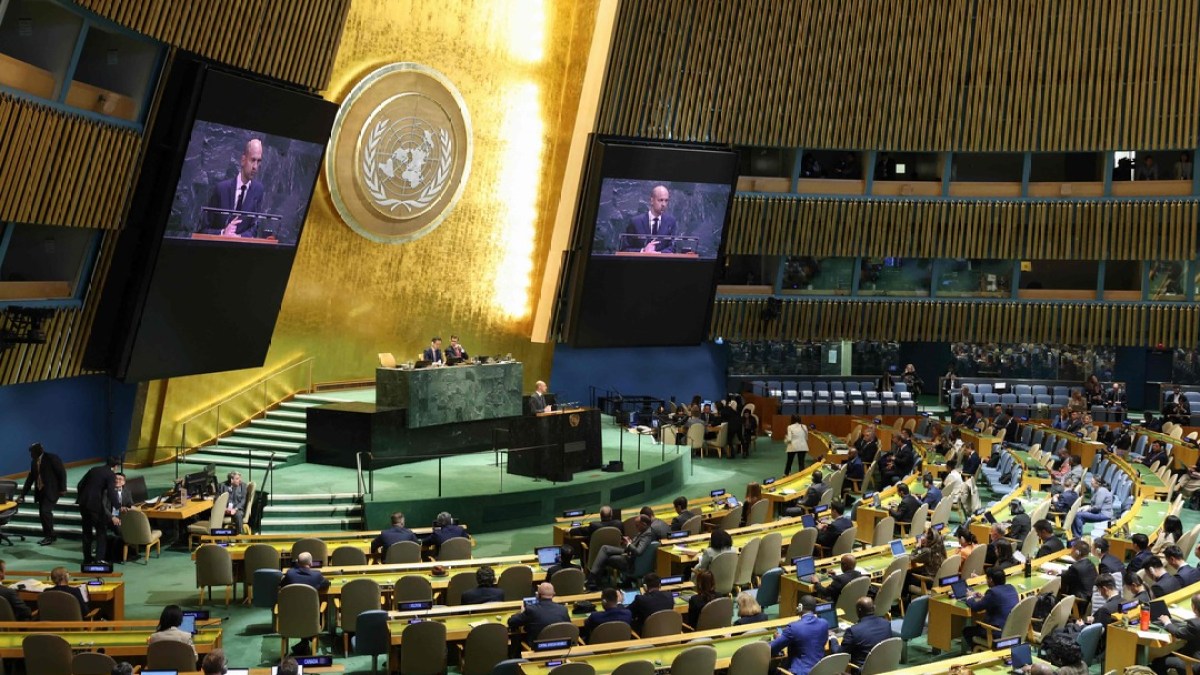
The United States' representative to the United Nations, Robert Wood, sharply criticized China and Russia, accusing them of using their veto power to block international resolutions intended to enhance navigation security in the Strait of Hormuz. Wood deemed this behavior as reflecting a "prioritization of political interests over international obligations."
During his speech at the UN Security Council meeting, Wood accused Iranian-backed entities, including armed groups, of carrying out attacks on ships over the past two years, describing this as one of the most serious threats to maritime navigation in modern times.
Details of the Event
The American envoy emphasized the necessity of holding Iran accountable for what he termed "widespread violations" that include the UN Charter, maritime law, international humanitarian law, Security Council resolutions, and commitments to nuclear non-proliferation. He also characterized the planting of mines in international waterways as "piracy" that directly threatens international security.
Wood delivered a pointed intervention, focusing on what he described as "escalating threats" facing international maritime corridors, stressing that no country should use the Strait of Hormuz as a bargaining chip or political hostage, in a direct reference to Iran.
Background & Context
These statements come at a sensitive time as the UN Security Council holds a high-level meeting to discuss the issue of "freedom of navigation and protection of international waterways," amid rising tensions in several vital maritime points, particularly the Strait of Hormuz. The session was chaired by the Foreign Minister of Bahrain, Abdul Latif bin Rashid Al Zayani, who invited several senior officials and international experts to participate.
The UN Secretary-General, Antonio Guterres, provided a comprehensive briefing on the economic and humanitarian dimensions of the navigation crisis, emphasizing that maritime corridors represent the arteries of global trade that transport food, energy, and goods between continents. He noted that the Strait of Hormuz is one of the most important strategic passages in the world.
Impact & Consequences
Guterres pointed out that the current crisis has led to direct consequences, including rising shipping and insurance costs, disruption of supply chains, and delays in humanitarian aid delivery. He also mentioned that thousands of sailors are stranded at sea under difficult conditions, calling for the establishment of an organized international mechanism to evacuate affected maritime crews.
The Secretary-General of the International Maritime Organization, Arsenio Dominguez, confirmed that freedom of navigation is a fundamental principle of international law, and any attempt to close an international strait or impose transit fees constitutes a clear violation of international navigation agreements. He revealed that around 20,000 sailors are stranded and 2,000 ships are affected by the turmoil.
Regional Significance
These developments are of great importance to the Arab region, as the Strait of Hormuz is a vital point for transporting oil and gas to global markets. Any escalation in tensions could directly impact energy prices and Arab economies.
At the conclusion of the session, the French Foreign Minister, Jean-Noël Barrot, emphasized that maritime straits do not belong to any one country; rather, they are global arteries that should not be closed or taxed. He warned that accepting any exceptions to this principle would lead to the collapse of the international maritime system.