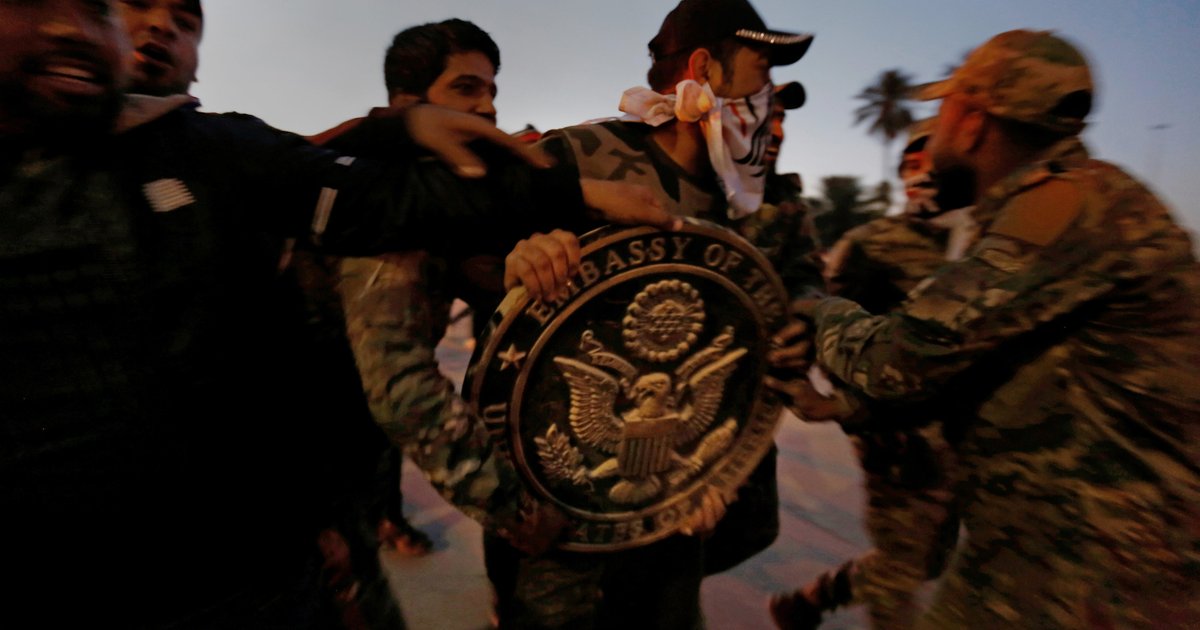
The U.S. Embassy in Baghdad has announced a reward of up to $3 million for anyone with information that could help identify or locate those responsible for attacks targeting its diplomatic missions in Iraq. This announcement was made in an official statement released by the embassy on Sunday, just a day after two separate attacks occurred against these missions.
The attacks that took place on Saturday evening have raised significant concerns within American diplomatic circles, as the frequency of assaults on diplomatic missions in Iraq has increased recently. The embassy confirmed that this reward is part of its efforts to enhance the security of its personnel and protect its missions.
Details of the Attacks
The first attack occurred in a fortified Green Zone, where mortar shells targeted one of the U.S. diplomatic facilities, resulting in property damage but no injuries. Meanwhile, the second attack targeted a diplomatic convoy as it was passing through a main street in Baghdad, causing panic among citizens.
These attacks come at a sensitive time, as the Iraqi government is striving to bolster security and stability in the country amidst ongoing political and security tensions. The U.S. Embassy has assured that it will continue to work with Iraqi authorities to ensure the safety of its personnel.
Background & Context
Iraq has witnessed a long-standing increase in attacks on diplomatic missions, particularly those of the United States. These attacks are often attributed to armed factions linked to Iran, which oppose the American presence in the region. The Iraqi government faces significant challenges in controlling these factions, complicating the security situation further.
In recent years, the U.S. Embassy in Baghdad has been subjected to several rocket and mortar attacks, prompting the United States to enhance its security and protection measures. This escalation in attacks reflects the increasing tensions between the United States and Iran and their impact on the security situation in Iraq.
Impact & Consequences
These attacks pose a direct threat to diplomatic security in Iraq and may lead the United States to reassess its military and diplomatic presence in the country. Such events are likely to affect the relations between Iraq and the United States, especially given the urgent need for security cooperation.
Moreover, these developments could escalate tensions between armed factions and Iraqi authorities, further complicating the security landscape in the country. The Iraqi government will find itself in a challenging position between protecting diplomatic missions and ensuring that tensions with armed factions do not escalate.
Regional Significance
The attacks on U.S. diplomatic missions in Iraq serve as an indicator of instability in the region and may impact relations between Arab countries and the United States. These events could lead to a reassessment of Arab countries' strategies in dealing with the American presence in the region.
Additionally, the rise in violence in Iraq could negatively affect regional security, prompting Arab nations to enhance security cooperation among themselves to face common challenges.
In conclusion, the situation in Iraq remains volatile, and the international community needs to closely monitor developments. Strengthening security and protecting diplomatic missions must be a top priority to maintain stability in the region.