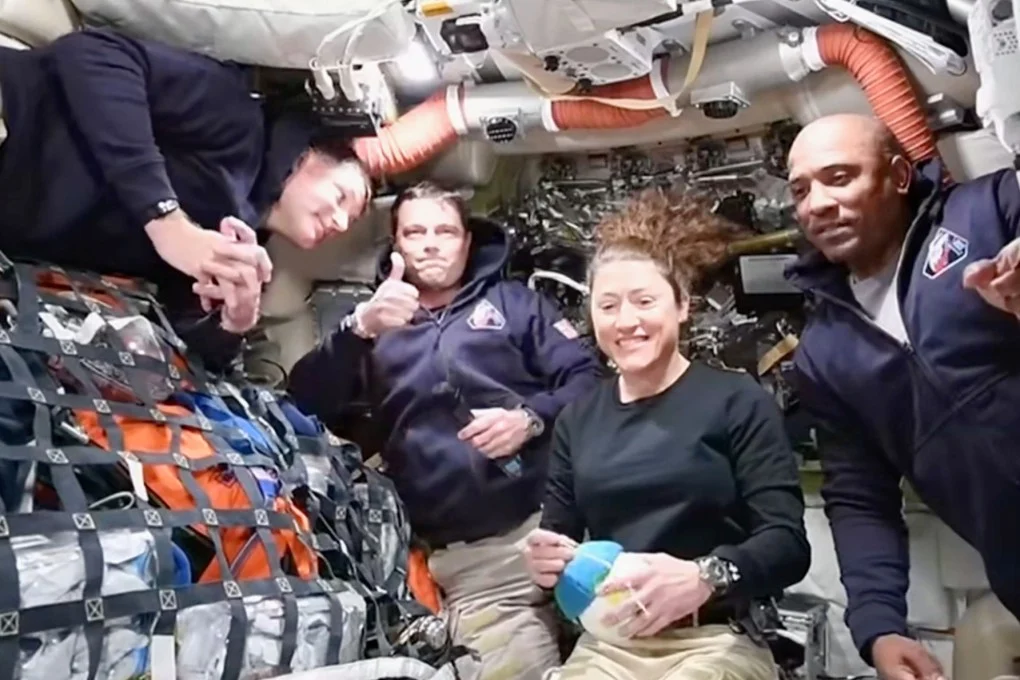
Four astronauts are living aboard the Orion spacecraft, facing daily life challenges such as fixing toilets and dealing with email issues. This unique mission represents a new step in space exploration, as NASA seeks to return humans to the Moon.
The current journey undertaken by these astronauts, which is part of the Artemis program, includes a range of activities that go beyond mere scientific exploration, as they must adapt to life in a confined and small environment, equivalent to the size of two minivans.
Details of the Mission
The mission crew consists of four astronauts, including Christina Koch, who is considered the first woman to go into deep space. Koch confirmed that preparing for this journey required extensive training, not only on scientific tasks but also on how to handle everyday situations that may arise in space.
Despite the significant challenges they face, the astronauts are trying to maintain morale by engaging in recreational activities such as drinking juices and sharing photos via their mobile phones, reflecting a human side to their lives in space.
Background & Context
Historically, space missions have been regarded as purely scientific adventures, with a focus on research and discoveries. However, the Artemis program represents a shift in this direction, aiming to integrate daily life with scientific exploration. This program is part of a larger vision to return humans to the Moon, with future plans to send astronauts to Mars.
The first human spaceflights date back to the 1960s, during a fierce competition between the United States and the Soviet Union. As technology advanced, space missions became more inclusive, allowing scientists and researchers to consider how to live and work in space for extended periods.
Impact & Consequences
This mission is part of broader efforts aimed at enhancing human understanding of space, as well as developing new technologies that may be beneficial on Earth. Improving living conditions in space can contribute to achieving larger goals such as sustainable colonization of other planets.
Furthermore, these daily experiences help in understanding how isolation and psychological stress affect astronauts, which can have implications for the design of future missions.
Regional Significance
As major countries advance in space exploration, Arab nations have also begun to invest more resources in this field. Space programs in the UAE, Saudi Arabia, and Egypt reflect a growing interest in technology and scientific research, potentially opening new avenues for international cooperation in space.
The success of these missions could inspire new generations in the Arab world to engage in science and technology, contributing to sustainable development in the region.
In conclusion, the journey of the four astronauts is not just a scientific mission; it is also a human experience that reflects the daily challenges faced by humans in space. As space exploration continues, hope remains for achieving new milestones that benefit all of humanity.