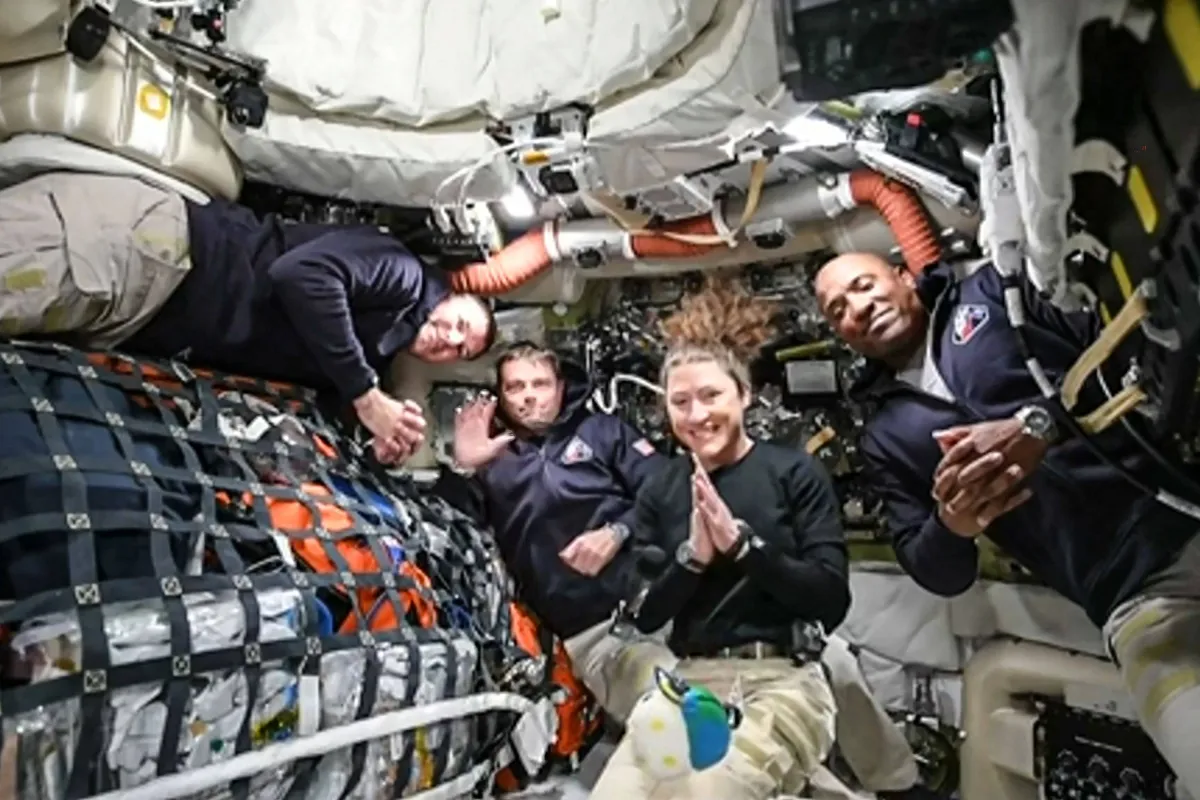
The four astronauts of the Artemis 2 mission are preparing to reach the farthest point ever achieved by humans from Earth, surpassing any previous spacecraft. This mission, considered the first flight near the Moon since 1972, will lead them to areas never directly seen by humans.
After more than 4 days since their launch from Florida, USA, the three NASA astronauts: Christina Koch, Victor Glover, and Reid Wiseman, along with their Canadian colleague Jeremy Hansen, entered the "Moon's gravitational range" at 04:42 GMT, where the Moon's gravity exceeds that of Earth.
Details of the Event
At around 18:00 GMT, the astronauts will break the record for the farthest space flight, previously set by the Apollo 13 crew in 1970. They will cover a distance of up to 406,000 kilometers away from Earth during the day.
Although the four astronauts will not land on the Moon's surface, this mission represents a historic event; none of the Apollo missions (1968 - 1972) included women, Black astronauts, or non-American astronauts in their crews.
Background & Context
In the history of space exploration, no Russian or Chinese astronaut has ventured beyond 400 kilometers from Earth, which is the distance to the orbital stations around Earth. Only spacecraft that returned to observe the Moon have done so.
The Orion spacecraft's window will fill the Moon for 7 hours, starting at 18:45 GMT. The Moon will appear to them the size of a "basketball on the tip of a hand," according to Noah Petro, head of NASA's Planetary Geology Laboratory.
Impact & Consequences
NASA hopes this event will ignite excitement among followers worldwide; the mission will be broadcast live on multiple platforms such as Netflix and YouTube, except for 40 minutes during which communications will be cut off due to the Moon's obstruction. Kelsey Young, the mission's chief scientist, promised that "hearing this crew describe the Moon's surface will send chills down your spine."
While the Apollo astronauts preceded them in this achievement, "most of us were not born yet, so this will be a unique experience for us," said Derek Pozas, an astronomy and astrophysics professor at the University of Chicago.
Regional Significance
This mission represents an opportunity for Arabs to engage with developments in space, as it can inspire new generations to explore science and technology. The international collaboration in this mission reflects the importance of global partnerships in achieving scientific goals.
In conclusion, the Artemis 2 mission represents a significant step towards deep space exploration, as it is expected to contribute to the development of new technologies that may be crucial for future missions to Mars.