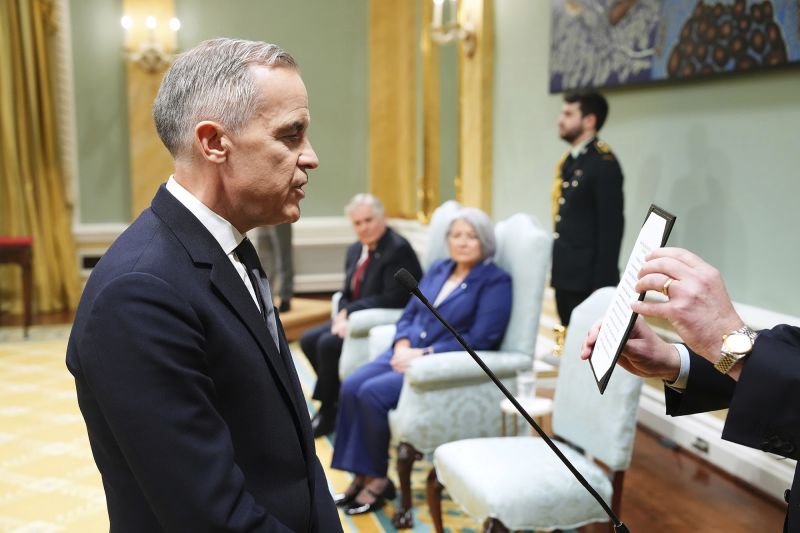
Canadian Prime Minister Mark Carney condemned the Israeli invasion of Lebanon on Tuesday, describing it as an "illegal invasion" that violates the sovereignty and territorial integrity of the country. This statement came during a press conference where Carney expressed his concern over the rising tensions in the region, noting that the Lebanese government is taking measures to combat Hezbollah's activities, which Israel has cited as justification for this invasion.
Carney affirmed that Canada is closely monitoring the situation, stressing the need to respect the sovereignty of nations and their right to protect their territories. He also pointed out that military escalation will only exacerbate the humanitarian situation in Lebanon, which is already suffering from multiple crises.
Details of the Event
Carney's remarks come at a sensitive time as fears grow over the expansion of conflict in the region. Several European countries have expressed concern over the implications of this invasion, warning that any escalation could destabilize Lebanon and neighboring countries. These nations have emphasized the importance of diplomatic dialogue as a means to resolve disputes.
In a related context, the Lebanese government has confirmed its commitment to combating the illegal activities carried out by Hezbollah, which Israel classifies as a major threat to its security. Nevertheless, the Israeli invasion is considered an unacceptable escalation, according to many international observers.
Background & Context
Historically, Lebanon has witnessed numerous armed conflicts, including civil wars and foreign interventions. Relations between Lebanon and Israel have been tense for decades, with the border between the two countries experiencing numerous clashes. Hezbollah, established in the 1980s, is considered one of the key players in this conflict, facing accusations from Israel of supporting terrorism.
It is noteworthy that Lebanon is suffering from severe economic and political crises, which complicates the situation further. The successive crises have led to a deterioration of humanitarian conditions, making any military escalation more dangerous for civilians.
Impact & Consequences
These events could lead to greater military escalation in the region, threatening regional security. The United Nations has warned that any escalation could result in a new humanitarian crisis in Lebanon, which is already facing shortages of essential resources.
International reactions may also play a significant role in determining the course of events. Major powers, including the United States and Russia, may intervene to mediate in the conflict, but this depends on the extent of rising tensions.
Regional Significance
The situation in Lebanon is part of a larger picture concerning stability in the Middle East. The tensions between Israel and Hezbollah may affect relations between Arab countries and Israel, especially in light of recent normalization agreements.
Moreover, any escalation in Lebanon could impact Palestinian and Syrian refugees in the country, further complicating humanitarian conditions. Under these circumstances, the international community must work towards peaceful solutions to ensure regional stability.
In conclusion, the situation in Lebanon remains under close observation, as the world looks to international responses to the Israeli invasion. Achieving peace and stability requires ongoing diplomatic efforts and cooperation among all parties involved.