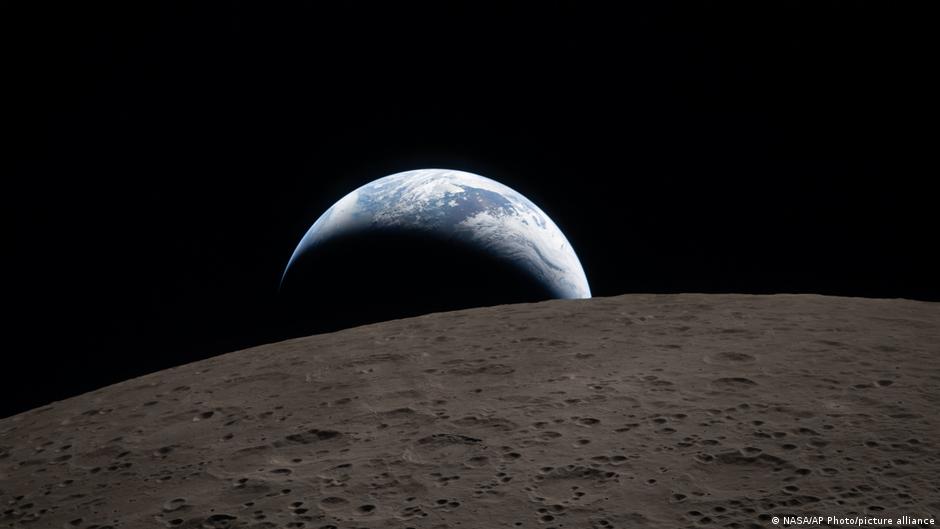
In a remarkable achievement in the realm of space exploration, the crew of the Artemis 2 mission managed to capture a stunning image showcasing Earth setting behind the lunar horizon, reflecting the significant progress humanity has made in exploring space. This event took place on Tuesday as they prepared to return to Earth's gravity after achieving a record-breaking distance traveled.
The mission, which is part of the Artemis program, saw the crew travel a distance of 252,756 miles (406,771 kilometers) away from Earth, surpassing the previous record set by the Apollo 13 mission in 1970 by over 4,000 miles.
Details of the Mission
The crew consists of four astronauts: Americans Reid Wiseman, Christina Koch, and Victor Glover, along with Canadian astronaut Jeremy Hansen. Glover is noted as the first person of African descent to orbit the Moon, while Koch is the first woman, and Hansen is the first non-American to participate in this mission.
The crew also experienced a unique astronomical event, donning protective glasses to witness a total solar eclipse, where the Moon obscured the Sun from their vantage point. These unique moments reflect the significant advancements humanity has made in space exploration.
Background & Context
The Artemis 2 mission is part of a larger program aimed at returning to the Moon, with plans for a potential human landing on the lunar surface by 2026. This program is part of NASA's efforts to explore deep space, develop new technologies, and enhance international cooperation in the field of space.
Previous explorations, such as the Apollo 8 mission that occurred in 1968, had profound impacts on our understanding of space. The iconic image captured by an astronaut during that mission, showing Earth rising above the lunar horizon, was a pivotal moment in space history.
Impact & Consequences
The Artemis 2 mission demonstrates how modern technology can revive the spirit of exploration that prevailed during the space race era. Achieving a new record in distance traveled is considered a significant accomplishment, reflecting the technological advancements made in recent decades.
This mission is also a step towards achieving larger goals, such as exploring Mars. The development of new technologies in space can contribute to improving life on Earth through innovations derived from these programs.
Regional Significance
The Artemis 2 mission represents a landmark in the history of space exploration, showcasing the technological progress and human achievements in this field. It not only highlights the capabilities of current space missions but also inspires future generations to pursue careers in science and technology.
As humanity continues to push the boundaries of space exploration, missions like Artemis 2 pave the way for future endeavors, including potential manned missions to Mars, thereby expanding our understanding of the universe.