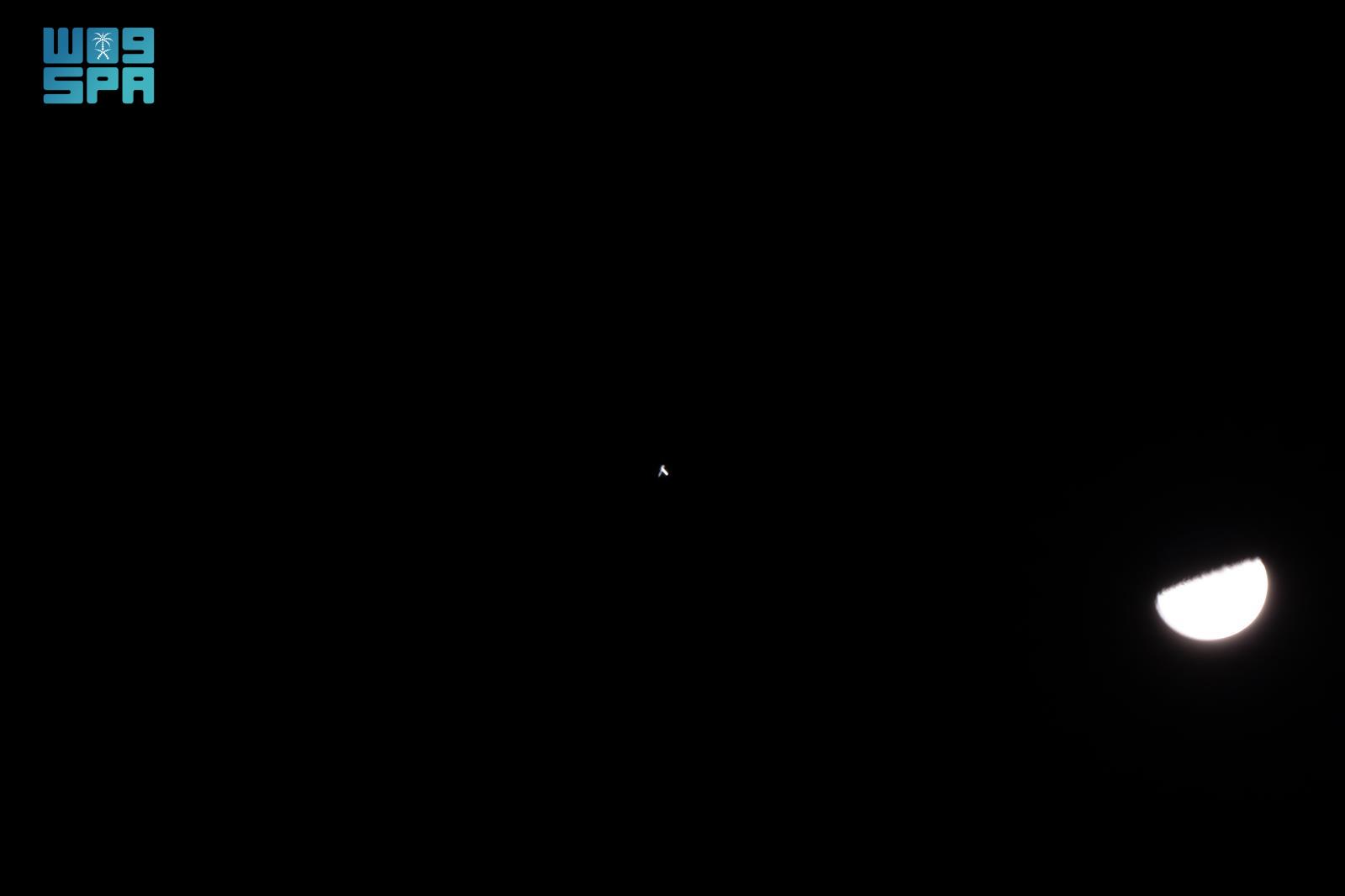
On the evening of Thursday, March 26, 2026, the Arab world experienced a stunning astronomical conjunction between the moon and Jupiter in the constellation Gemini, surrounded by the stars of the winter hexagon. This event provided astronomy enthusiasts with a remarkable opportunity to reflect on the beauty of the universe.
With rain falling in many Arab countries and the weather turning pleasant, Thursday night was a wonderful example for stargazing. The sky was adorned with its shining stars, making it an ideal destination for amateurs and astronomy lovers.
Details of the Event
On this night, the moon was in its first quarter phase, positioned in the sky opposite Jupiter, which sparkled beautifully in the constellation Gemini. This astronomical conjunction was not just a fleeting event; it was an opportunity to see the two stars representing the heads of Gemini, Castor and Pollux.
The moon, considered one of the most prominent celestial bodies, was in its well-known position among Arabs called "the arm," while Jupiter, the gas giant, shone like the queen of the sky. This beautiful astronomical scene was surrounded by the stars of the winter hexagon, a group of bright stars that appear in winter.
Background & Context
Historically, Arabs have looked to the sky and interpreted astronomical phenomena in various ways. They regarded the moon and Jupiter as symbols of time and space. Jupiter was seen as a planet carrying positive connotations, while the moon was considered a symbol of calmness and contemplation.
Jupiter is one of the largest planets in our solar system, orbiting the sun in a cycle that takes about 12 years. It has a collection of moons, the most famous of which are the four Galilean moons: Ganymede, Callisto, Io, and Europa, which add intricate details to the movement of the solar system.
Impact & Consequences
This astronomical conjunction represents more than just a transient phenomenon; it carries profound implications for our understanding of the universe. The constant movement of celestial bodies reminds us of the complexity of the cosmic system and invites us to reflect on our place in this vast universe.
Moreover, witnessing the moon and Jupiter together encourages contemplation of time and motion, as the succession of night and day reminds us that life continues, and celestial bodies will keep moving without pause.
Regional Significance
In light of the current circumstances faced by many Arab countries, these astronomical phenomena can serve as a source of inspiration for individuals and communities. They remind us of the beauty of nature and its ability to bring joy to people's hearts.
Additionally, these phenomena enhance the importance of astronomical education in the region, as they can inspire new generations to explore science and astronomy, contributing to the development of scientific and cultural knowledge in Arab communities.
In conclusion, the conjunction between the moon and Jupiter remains a call for contemplation and reflection, reminding us that the universe is full of mysteries and beauty, and that we are part of this magnificent cosmic system.