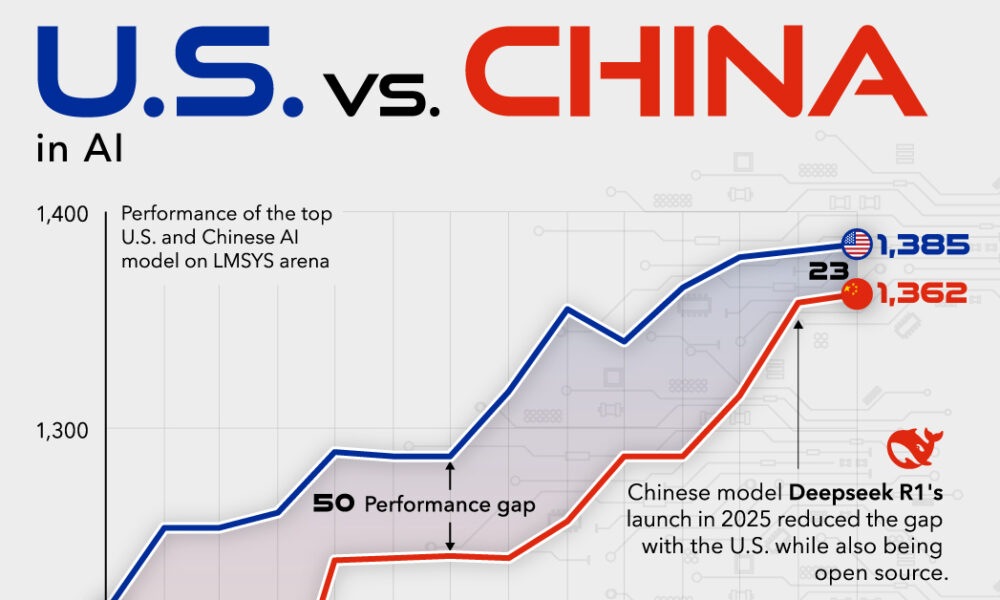
Chinese semiconductor companies reported record revenues last year, with a revenue increase of 16% reaching $9.3 billion. This growth is attributed to the rising demand for artificial intelligence, a shortage of memory chips, and U.S. restrictions that have pushed Beijing to enhance its local technology industry.
Companies and analysts expect this revenue growth to continue this year, highlighting how Chinese firms are benefiting from strong demand from local tech giants seeking to build advanced AI infrastructure.
Event Details
Semiconductor Manufacturing International Co. (SMIC), China's largest chip manufacturer, reported a 16% increase in its revenues for 2025 compared to the previous year, with revenues expected to exceed $11 billion in 2026, according to analyst estimates.
Additionally, Hua Hong, another Chinese company, announced that its revenues for the fourth quarter of last year reached $659.9 million, with sales projections ranging between $650 million and $660 million.
Background & Context
This revenue increase comes amid rising demand for chips due to the growth of the electric vehicle sector and related infrastructure, which has supported demand for less advanced chips. The demand for advanced chips has also seen a significant rise due to artificial intelligence, as noted by Paul Triolo, a partner at Albright Stonebridge Group.
Despite U.S. restrictions imposed on the technology sector in China in recent years, these constraints have accelerated Beijing's efforts toward achieving technological self-sufficiency, prompting local companies to enhance their capabilities.
Impact & Consequences
Data shows that U.S. restrictions on technology exports to China have increased demand for local chips, stimulating companies to seek local alternatives. For instance, restrictions on Nvidia chips have encouraged Chinese companies like Huawei to develop local alternatives, although the performance of these chips still lags behind their American counterparts.
Memory chip companies in China have also seen a significant increase in revenues, with ChangXin Memory Technologies (CXMT) reporting a 130% year-on-year revenue increase, surpassing 55 billion yuan (approximately $8 billion).
Regional Significance
These developments in the Chinese semiconductor industry are particularly significant for the Arab region, as they may impact technology investments in Arab countries. With the increasing reliance on modern technology, Arab nations may seek to strengthen partnerships with Chinese companies to capitalize on this boom in the semiconductor industry.
In conclusion, these figures indicate a significant shift in China's technology industry, as the country aims for self-sufficiency amid global challenges. As demand for chips continues, the question remains how China will respond to future technological challenges.