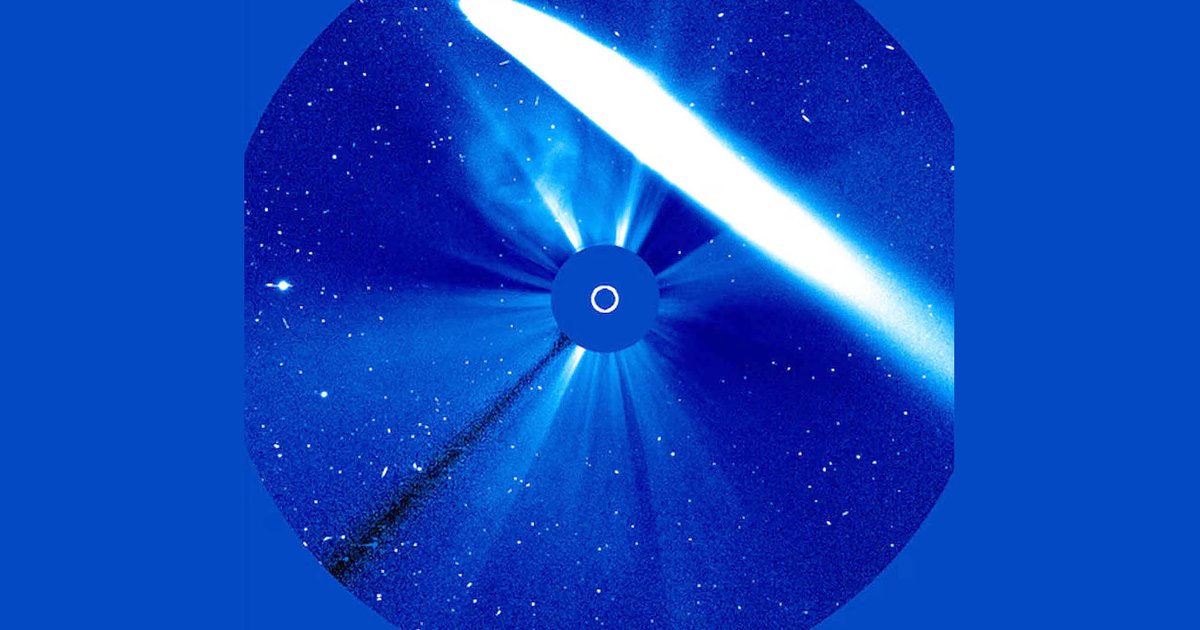
The comet MAPS (MAPS-C/2026 A1) met its demise after getting too close to the sun, dying in the solar corona on Sunday, April 5. The comet passed at an altitude of about 160,000 kilometers above the sun's surface and was captured by the coronagraph cameras aboard the SOHO spacecraft as it headed towards its end.
The observations were recorded by the 'C1' and 'C2' coronagraph instruments, which documented the comet's fatal plunge that was not visible from Earth. The recordings showed a sudden increase in brightness between 6 AM and 8 AM UTC, indicating an explosion of the comet's nucleus due to the extreme thermal stress it experienced.
Details of the Event
While the comet was behind the occulting disk of the coronagraph, the disintegrating nucleus completely vaporized, leaving only a stream of dust that emerged from the other side. Data from the SOHO observatory continues to flow, indicating the possibility of detecting more remnants of this debris in the coming hours.
Astronomers had hoped for a different outcome, as comet MAPS was discovered in January 2026 at a distance farther from the sun than any other "sun-grazing" comet in history. It was believed to be large enough to survive and possibly appear in daylight, but the ending was entirely different.
Background & Context
Historically, humanity has witnessed many comets approaching the sun, but comet MAPS was unique due to its significant distance at the time of discovery. This discovery piqued scientists' interest, as it was thought that this comet could provide valuable information about the composition of comets and how they interact with the sun.
Comets are fascinating astronomical phenomena that attract the attention of both scientists and amateurs alike. Studying their behavior as they approach the sun can yield insights into the nature of the materials they are composed of, as well as the physical processes occurring in the solar corona.
Impact & Consequences
The death of comet MAPS raises questions about how environmental conditions in space affect celestial bodies. This event highlights the sun's power and its gravitational and thermal influence on objects that come near it.
Moreover, this event opens the door for further research on other comets that may approach the sun in the future, helping scientists gain a better understanding of the solar system's formation and history.
Regional Significance
For the Arab region, astronomical events like the death of comet MAPS generate significant interest, as many Arab astronomers strive to follow such phenomena. Understanding how comets interact with the sun can help enhance astronomical knowledge in the region.
In conclusion, this event serves as a reminder of the sun's power and its impact on celestial bodies, reflecting the importance of scientific research in understanding cosmic phenomena.