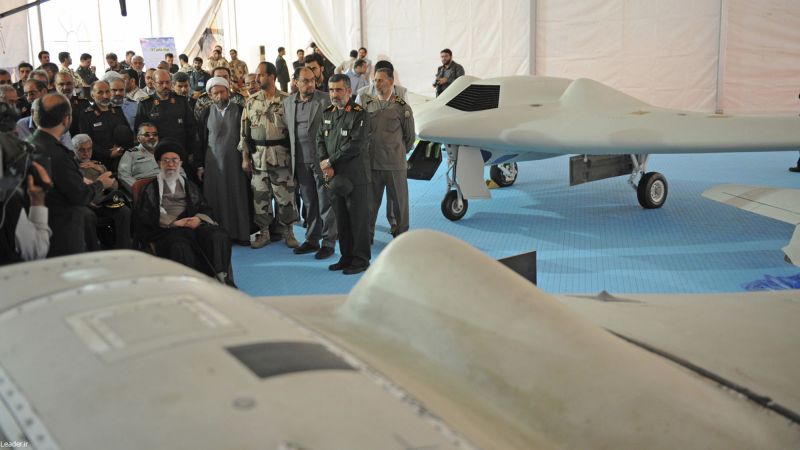
A comprehensive report by journalist Heather Somerville in the Wall Street Journal highlights a radical shift in U.S. military armament strategies, with the emergence of the attack drone 'Lucas' as one of the most significant weapons in current confrontations.
What is intriguing about this development is that this drone is not a product of innovations from major defense companies; rather, it is an American-developed version that has been replicated through reverse engineering of Iranian-origin technologies, specifically the 'Shahed' drone, which gained notoriety for its effectiveness and low cost.
Details of the Development
Somerville reports that senior defense officials have confirmed that 'Lucas' has achieved overwhelming success in targeting Revolutionary Guard facilities and drone manufacturing sites, contributing to an 83% reduction in Iranian attacks during the initial days of the conflict. A former defense official describes this drone as the 'Toyota Corolla of drones'; it is not complex or expensive, but practical and affordable, with costs ranging between $10,000 and $55,000, a trivial amount compared to the $2 million price tag of a Tomahawk missile.
Michael Horowitz, a former Pentagon official and one of the leaders of the project development team, explains that the historical issue was not America's inability to produce precise weapons, but rather that it had not spent a single dollar on such low-cost systems.
Background & Context
The U.S. military has managed to bypass traditional bureaucracy by owning the intellectual property for this weapon, relying on second and third-tier manufacturing companies to produce massive quantities of up to 300 drones per month for each factory. Politically, the author notes that the Trump administration implemented comprehensive reforms in defense procurement, where Defense Secretary Pete Hegseth's decision to eliminate complex acquisition requirements has effectively accelerated the deployment of this drone.
However, the report conveys warnings from experts like Jack De Santis, an electronic warfare specialist, who believes that the success of this drone in an environment without strong electronic jamming does not guarantee its superiority in more complex conflicts with countries possessing advanced technological capabilities.
Impact & Consequences
These developments indicate a shift in U.S. armament strategies, as the country seeks to adopt more effective and less costly technologies. This shift could alter the balance of power in future conflicts, especially amid increasing threats from countries like Iran.
It is worth noting that the U.S. government still lacks the necessary range of modern and inexpensive systems to meet rapidly evolving technological challenges, which serves as a warning bell for Washington in light of the new global arms race led by unmanned aerial vehicles.
Regional Significance
Concerns are rising in the Arab region that the use of such drones may escalate conflicts, particularly amid ongoing tensions with Iran. Additionally, this development could encourage other countries in the region to enhance their military capabilities, potentially leading to a new arms race.
In conclusion, these developments reflect the importance of innovation in the defense sector and underscore the need for new strategies to address the increasing challenges in a world characterized by complexity and rapid change.