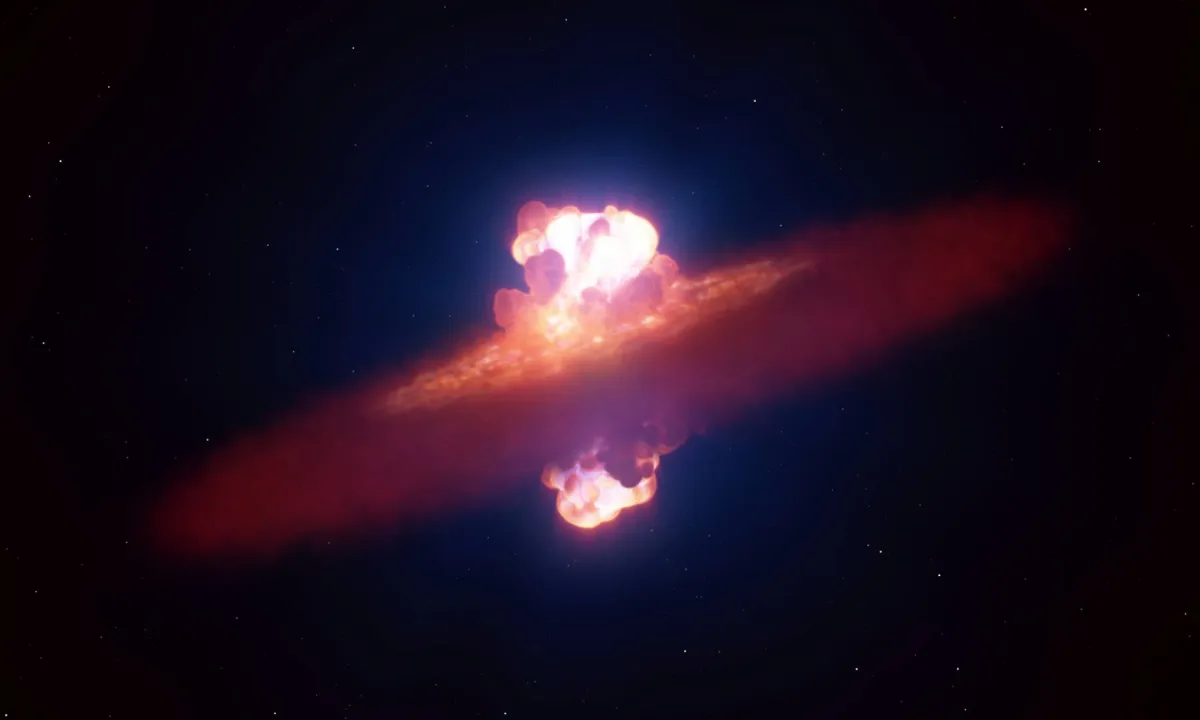
Astronomers have uncovered indirect evidence suggesting that some giant stars may explode without leaving any remnants, altering our understanding of stellar life cycles. This discovery comes as part of a new study published in the journal 'Nature', where research showed that powerful stellar explosions, known as 'pair-instability supernovae', may occur in stars that exceed the mass of the Sun by a factor of between 140 and 260.
This phenomenon is intriguing because explosions at the end of a star's life typically leave behind stellar remnants such as black holes or neutron stars. However, according to the researchers, some giant stars may be so powerful that they explode without leaving any trace.
Details of the Event
Hui Tong, a PhD student in astrophysics at Monash University in Australia, reported that these explosions occur in stars with immense masses, which have relatively short lifespans of only a few million years. In comparison, the Sun has a lifespan of about 10 billion years, meaning that giant stars burn out approximately a thousand times faster.
When large stars explode, some leave behind a neutron star, while others leave a black hole. However, the new study indicates an absence of black holes with masses ranging from 44 to 116 times that of the Sun, a phenomenon referred to by researchers as the 'forbidden range'. This absence could be interpreted as a result of giant stars exploding without leaving any remnants.
Background & Context
The theory of these powerful stellar explosions dates back to the 1960s, but current evidence enhances our understanding of this phenomenon. Researchers examined data on 153 pairs of black holes and were able to identify black holes formed through previous mergers.
These findings represent a significant step in space studies, opening the door to a deeper understanding of how stars evolve and their ultimate fate. Additionally, these discoveries may impact our overall understanding of the universe, including how galaxies and stars are formed.
Impact & Consequences
These discoveries hold great significance in the field of astrophysics, as they could lead to a reevaluation of current theories regarding the end of stellar life. If this phenomenon is confirmed, it may affect the models used to understand the evolution of stars and galaxies.
Moreover, these results could open new avenues for research in other fields, such as the study of gravitational waves and black holes, thereby enhancing our understanding of the universe and its evolution.
Regional Significance
For the Arab region, these discoveries underscore the importance of scientific research in the fields of space and physics. These findings can inspire a new generation of scientists and researchers in the Arab world and emphasize the importance of investing in education and scientific research.
In conclusion, these discoveries represent a new step toward a deeper understanding of the universe and pave the way for further research and studies in the future.