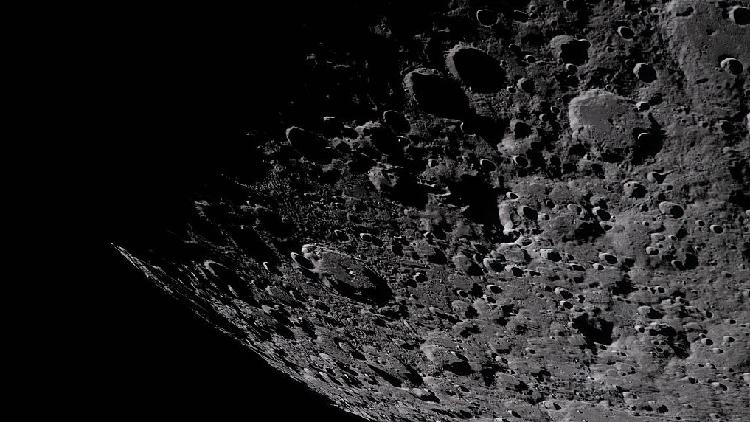
Scientists from Israel and the United States have revealed that ice has been slowly accumulating at the Moon's poles for at least 1.5 billion years, according to a statement from the Weizmann Institute of Science in Israel. This discovery opens new avenues for understanding the Moon's history and evolution, suggesting that the Moon may be more complex than previously thought.
This study involved advanced techniques for monitoring the lunar surface, allowing scientists to analyze data with precision. The results showed that ice exists in permanently shadowed regions where sunlight does not reach, preventing this ice from melting.
Details of the Discovery
These discoveries are related to multiple research projects, utilizing data from various spacecraft, including India's Chandrayaan-1 and Russia's Luna-25. This data helped identify locations of ice accumulation on the lunar surface, enhancing scientific understanding of how ice forms in harsh environments.
Scientists also noted that these findings could assist in planning future lunar exploration missions, including the potential use of ice as a water source for human missions.
Background & Context
Historically, the Moon has been considered an inactive body, but recent discoveries indicate it contains natural resources that could be beneficial for future missions. For decades, there have been attempts to understand the Moon's geological composition, but this study represents a significant step toward deeper understanding.
In recent years, international interest in the Moon has increased, with several countries announcing plans for exploration, including the United States, Russia, and China. This discovery adds a new dimension to these efforts, as ice could be a vital source of water and energy.
Impact & Consequences
This discovery could have a significant impact on space exploration plans, providing valuable information on how to utilize natural resources in space. If the presence of ice is confirmed in large quantities, the Moon could become a launch point for deeper missions into the solar system.
Moreover, this discovery may influence research related to climate change on Earth, as studying lunar ice could provide insights into how environmental conditions affect ice formation.
Regional Significance
For Arab countries, this discovery could hold particular importance, as some nations may participate in space exploration projects. Additionally, international cooperation in this field could enhance the standing of Arab nations in the global scientific arena.
In conclusion, this discovery represents an important step toward a better understanding of the Moon's history and may open new horizons for space exploration, reflecting the significance of scientific research in advancing human knowledge.