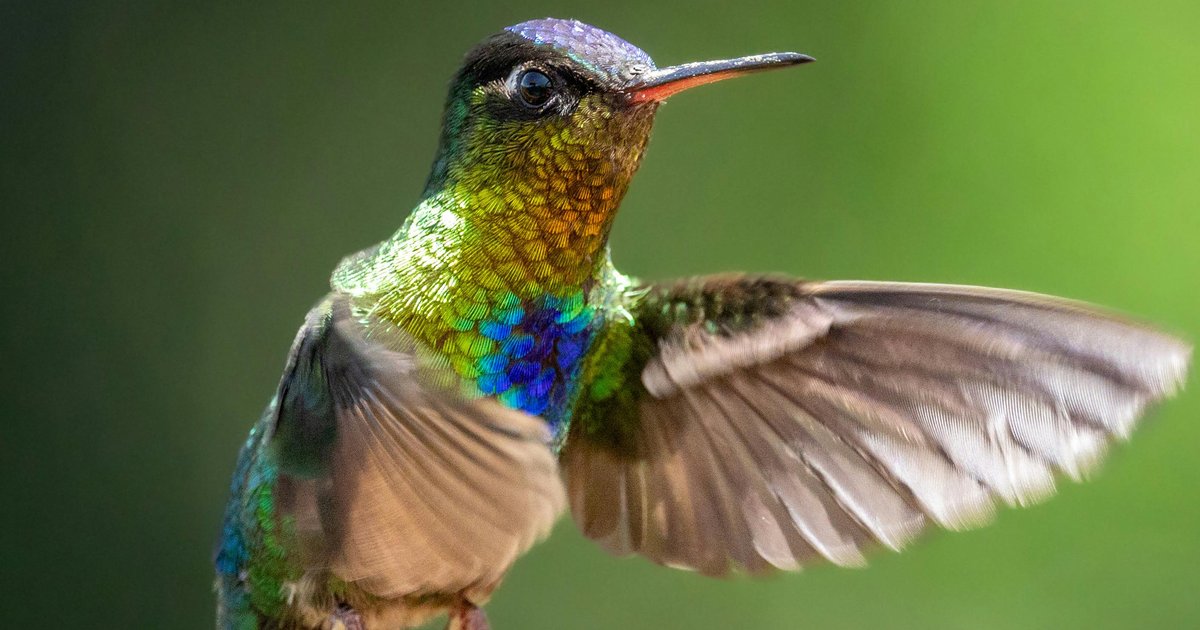
Hummingbirds are unique beings with exceptional flying capabilities, able to hover like miniature helicopters and dart forward or even backward in fractions of a second.
These birds appear in rapid scenes, flitting in front of flowers, gathering food, and pollinating plants, only to suddenly change direction to avoid dangers. Their swift and complex movements represent one of the most intricate kinetic phenomena in the animal world.
Event Details
Hummingbirds are characterized by their rapid wing flapping, reaching up to 80 beats per second, and can achieve 200 beats during mating or diving. This speed grants them exceptional precision and quickness, making it difficult to see their wings while in flight, though they can be heard buzzing distinctly.
This rapid flapping relies on a specialized physical structure, as hummingbirds possess massive pectoral muscles that make up over 30% of their body weight, explaining their ability to sustain flight and maneuver in the air.
Background & Context
Studies show that hummingbirds have some of the most specialized and efficient muscles in the animal kingdom, containing a high density of mitochondria responsible for converting nutrients into energy. This allows them to produce a significant amount of mechanical energy continuously.
Their wings have an extremely low mass, enabling them to execute precise and rapid aerial maneuvers. These birds rely on a complex mechanism in their wing movement, rotating their wing wrists during motion, which alters the wing angle and allows it to move in a figure-eight pattern.
Impact & Consequences
These abilities allow hummingbirds to hover steadily in the air, an achievement no other birds can replicate. They can also move sideways through openings narrower than their wingspan, showcasing their precise perceptual and motor skills.
These skills are essential for their feeding, as hummingbirds depend on extracting nectar from flowers, which requires them to hover backward to access food sources that are otherwise difficult to reach.
Regional Significance
Hummingbirds represent a unique model in nature, reflecting the ability of living organisms to adapt to their environments. In the Arab world, these birds can symbolize biodiversity and the importance of environmental conservation.
Studying these birds may also inspire the development of new technologies in aviation, enhancing innovation in technological industries.
In conclusion, hummingbirds are not just beautiful creatures; they challenge traditional constraints of flight and demonstrate how nature can inspire innovation and development across various fields.