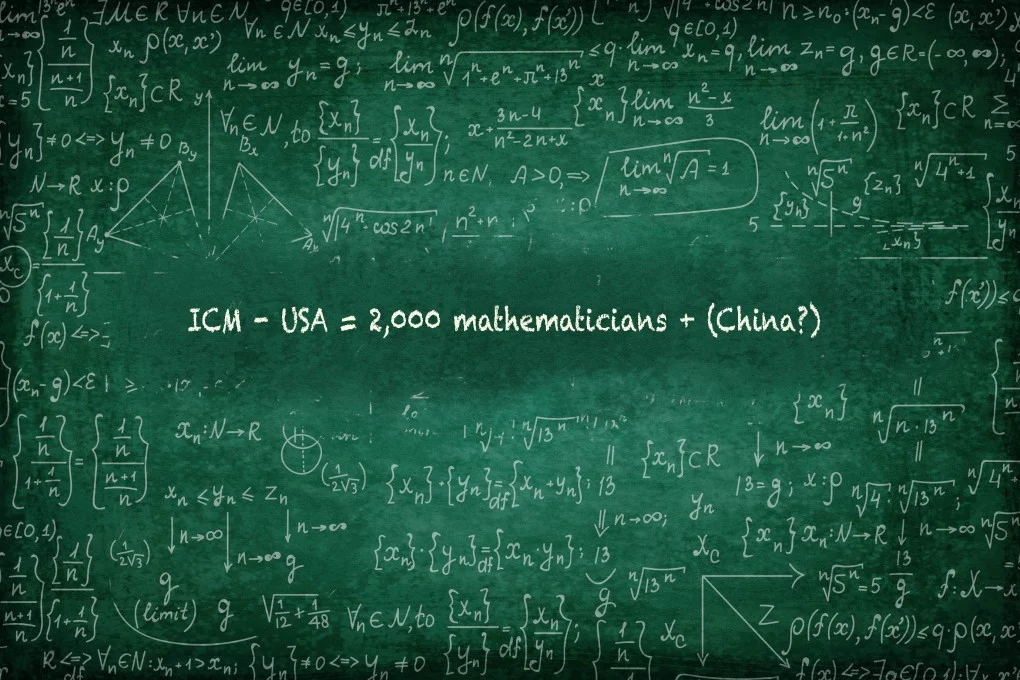
The global pressure on the United States is mounting due to its hosting of the International Congress of Mathematicians (ICM) scheduled for next July. This conference, regarded as the most significant in the field of mathematics and known for awarding the prestigious Fields Medal, is facing strong opposition from the international mathematics community.
More than 2,300 mathematicians from 76 countries have signed an online petition calling for the relocation of the 2026 conference from the United States. This move comes as part of increasing protests against current American policies, which many scientists view as incompatible with the values of international scientific collaboration.
Event Details
The International Congress of Mathematicians is held every four years, bringing together leading scientists and researchers in the field. However, the decision to host the event in the United States in 2026 has raised concerns among many, who believe it could negatively impact international participation. The petition circulating online reflects feelings of frustration regarding current American policies, including laws perceived as discriminatory.
The petition explicitly calls for scientists worldwide to refrain from participating in the conference if it remains in the United States. The signatories have indicated that this decision is part of their support for values of cooperation and mutual respect within the scientific community.
Background & Context
Historically, the United States has been a major center for scientific research, hosting numerous global conferences across various fields. However, political and social tensions in recent years have led to a decline in this role. Many scientists feel that current policies threaten the freedom of research and international collaboration.
In recent years, we have witnessed several attempts by scientists to express their concerns regarding American policies, including boycotts of certain scientific events. These movements reflect a shift in how scientists perceive the role of the United States in the global scientific community.
Impact & Consequences
If this trend continues, it could lead to a significant decline in participation from scientists from various countries in events held in the United States. This may affect the quality of research and scientific discussions conducted at these conferences. Furthermore, it could open the door for other countries to emerge as new centers for scientific research.
It is essential to understand that these movements are not merely transient reactions but reflect a deep concern about the future of scientific collaboration. Scientists recognize that scientific research requires an open and inclusive environment, and any restrictions could lead to a decline in innovation and progress.
Regional Significance
For the Arab region, these developments may carry significant implications. Many Arab scientists rely on collaboration with American institutions for their research. If these trends persist, Arab scientists may need to seek new partnerships with other countries, potentially leading to changes in research and development trajectories in the region.
Moreover, these events could present an opportunity for Arab countries to enhance their investments in scientific research and develop new educational programs, contributing to the establishment of a comprehensive and sustainable scientific community.