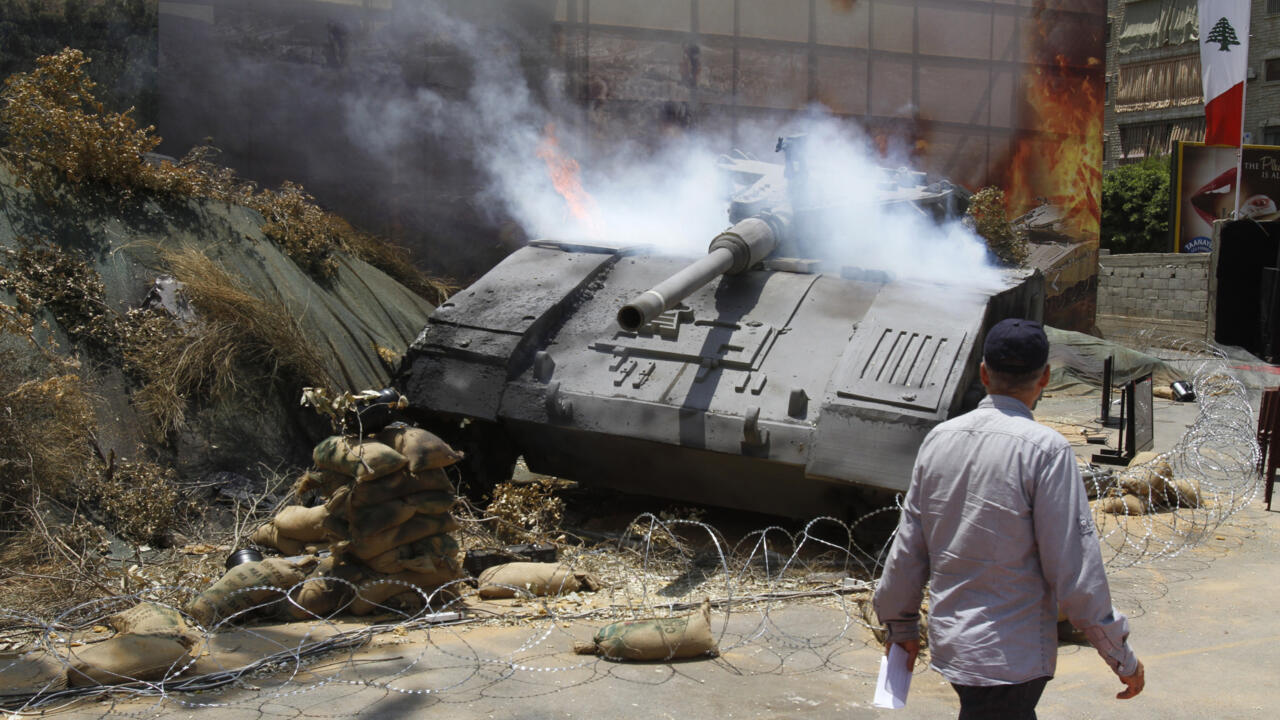
In a new military escalation, Hezbollah announced the destruction of 21 Israeli Merkava tanks, three bulldozers, and two military vehicles of the Humvee type in southern Lebanon. These attacks were carried out using small suicide drones, making them a military and media nightmare for the Israeli army.
These developments come at a time when fighting between Israel and Hezbollah is renewed, as the Shiite group has resorted to the intensive use of small kamikaze drones after previously relying on missiles and munitions like the Coronet. These drones have shown their effectiveness in the Russian-Ukrainian conflict, where they were widely used to target Russian forces.
Details of the Event
On March 25, 2026, Hezbollah released videos documenting the attacks, showing drones dropping explosives on Israeli tanks and military vehicles. Military reports confirmed that these tactics represent a shift in modern warfare methods, allowing Hezbollah to target vulnerabilities in Israeli armor.
According to the American website Defense News, the images released by Hezbollah reflect the use of tactics similar to those employed by Ukrainian forces against Russian troops. The Israeli army has acknowledged that several of its soldiers were injured as a result of these attacks.
Background & Context
Hezbollah began using these warfare tactics in 2024, but on a limited scale. With the outbreak of the new war on March 2, following missile launches at Israel amid the American-Israeli conflict over Iran, the use of suicide drones has become a strategic weapon for the group.
These drones, known as FPV, are characterized by their lightweight design and high effectiveness, made from materials like carbon fiber and aluminum, making them quieter and more maneuverable in the rugged terrain of southern Lebanon.
Impact & Consequences
These drones are considered a lethal weapon, capable of accurately targeting tanks and military vehicles. Retired Lebanese Brigadier General Ali Abi Raad points out that the warhead used by these drones resembles an RPG shell, increasing their explosive power.
Despite the advanced technological capabilities of the Israeli army, it has so far been unable to fend off these drones. This is due to the use of fiber optic cables for their guidance, complicating the task of jamming them by Israeli radars.
Regional Significance
These developments represent a shift in the balance of power in the region, reflecting Hezbollah's ability to utilize modern technology in conflict. The use of suicide drones could change warfare strategies in the area and enhance the capabilities of armed factions to carry out complex operations.
In conclusion, it can be said that these drones have become an essential part of military strategies worldwide, potentially leading to significant losses among enemy forces. Hezbollah's ability to bring the battle to the territory of the Israeli state reflects a transformation in the nature of the conflict in the region.