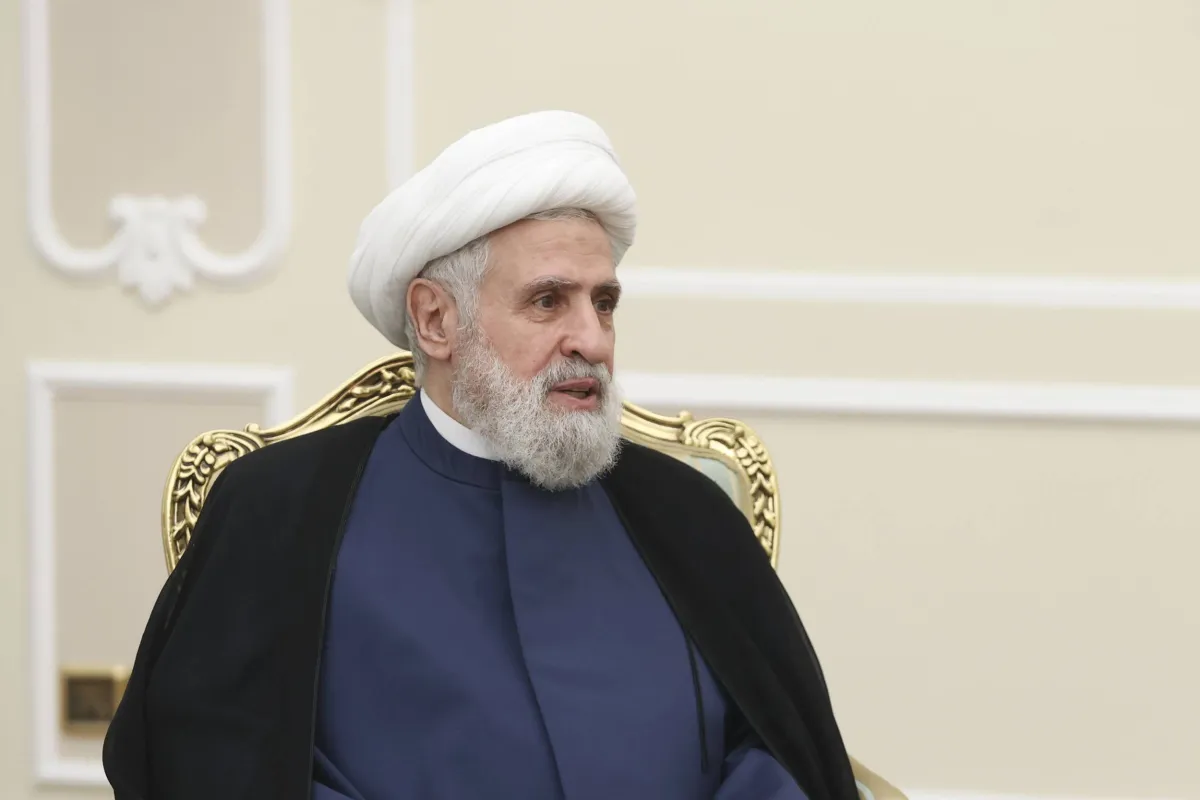
Hezbollah's Secretary-General, Naeem Qassem, announced on Monday the party's firm rejection of direct negotiations with Israel, describing it as a "serious sin" that could destabilize Lebanon. This statement comes at a time when the country is witnessing increasing military escalation between Hezbollah and Israel, with both sides exchanging accusations of violating the truce.
In a statement published by Hezbollah-affiliated media, Qassem said: "We categorically reject direct negotiations, and those in power should know that their actions will not benefit Lebanon or themselves." He emphasized that the Lebanese government must retract this dangerous step, stressing that direct negotiations with the Israeli enemy do not concern them in any way.
Details of the Incident
Qassem's remarks come amid rising military tensions, as the Lebanese Ministry of Health reported the deaths of 14 people in Israeli airstrikes on southern Lebanon, marking the deadliest day since the truce began. These airstrikes have resulted in a total of 36 fatalities since the start of the ceasefire, according to statistics from the Lebanese Ministry of Health.
In response, Israeli Prime Minister Benjamin Netanyahu accused Hezbollah of violating the truce, asserting that the Israeli army is targeting the party "with force." He indicated that Israel will do whatever is necessary to restore security to its borders.
Background & Context
The ceasefire agreement came into effect on April 17 following a round of negotiations between the ambassadors of Israel and Lebanon in Washington. The agreement was initially set to last for 10 days, but U.S. President Donald Trump announced its extension for an additional three weeks after a second round of talks.
Historically, relations between Lebanon and Israel have been marked by ongoing tensions, with several rounds of military conflict. Hezbollah had launched rockets at Israel in early March, escalating the situation in the region.
Impact & Consequences
Concerns are growing that these developments could lead to a greater escalation in the conflict between Hezbollah and Israel, which may negatively impact Lebanon's stability. Additionally, the continuation of Israeli airstrikes could exacerbate the humanitarian situation in the affected areas.
On the other hand, these events may influence the political situation in Lebanon, as Hezbollah faces internal and external pressures due to its military escalation. The Lebanese government's position may also be tested under these tense circumstances.
Regional Significance
The ongoing events between Hezbollah and Israel are part of a broader conflict in the region, where regional and international interests overlap. Any military escalation could have repercussions on neighboring countries, including Syria and Palestine.
In conclusion, the situation in Lebanon and Israel remains volatile, with increasing fears of a new conflict that could drag the entire region into a cycle of violence and instability.