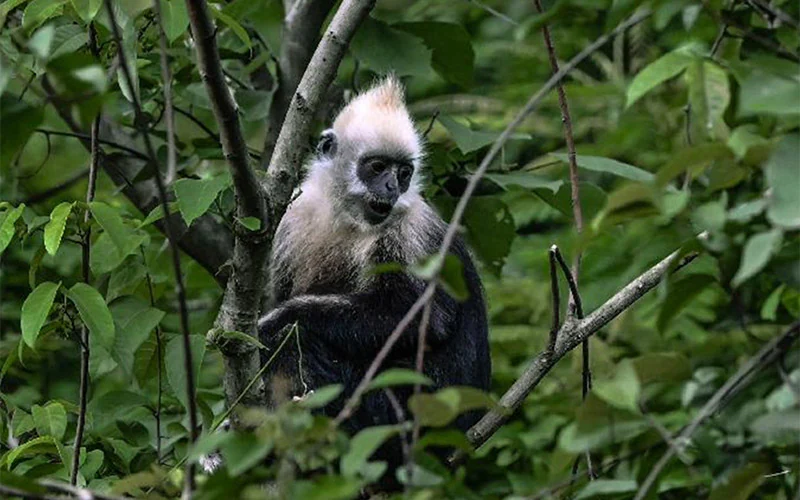
Chinese technology company Huawei has announced the deployment of an advanced artificial intelligence system to support the conservation efforts for the white langur in the Chongzuo National Reserve, located in the Guangxi Zhuang Autonomous Region. The white langur is considered critically endangered, with its population not exceeding 1,400 individuals, making it rarer than the giant panda.
This initiative is part of a comprehensive effort involving the government, researchers, and the private sector. Ng Dingban, the director of the reserve, emphasized that collaboration among these parties enhances the effectiveness of conservation through the use of digital technology.
Event Details
The Chongzuo National Reserve spans an area of 256 square kilometers, where approximately 90% of the white langur population resides. An intelligent monitoring platform based on artificial intelligence has been developed to observe these monkeys, allowing for the collection of vital data regarding their distribution and environmental conditions.
Video monitoring devices have been installed along the slopes, enabling real-time data collection on the langurs' activities and their surrounding environmental conditions. Reports indicate that the system has recorded over 37,200 instances of langur activity, reflecting the technology's effectiveness in enhancing conservation efforts.
Background & Context
Historically, white langurs lived in strict communities that prohibited inbreeding, complicating their reproduction. In the 1980s, their numbers plummeted to just 300 monkeys, but thanks to current conservation efforts, the population has risen to over 1,400 individuals.
This species of monkey is part of China's environmental heritage and has been classified as a protected species under national laws. However, challenges they face include habitat destruction and difficulty accessing rugged mountainous areas.
Impact & Consequences
The Chongzuo experience highlights the importance of collaboration between the government and the private sector in environmental protection. The use of artificial intelligence and modern technologies enhances reserves' capabilities to monitor endangered species more effectively.
This model can also be applied in other countries, such as Indonesia, where many species face environmental threats. Providing governmental support and scientific research can contribute to improving conservation efforts.
Regional Significance
In the Arab world, there is a growing need for similar strategies to protect endangered species, such as the Arabian leopard and the Arabian oryx. Modern technology can enhance conservation efforts, reflecting the importance of collaboration between governments and the private sector.
In conclusion, Huawei's experience in protecting the white langur serves as a model for biodiversity conservation, and Arab countries should leverage these experiences to develop effective strategies for protecting their environment.