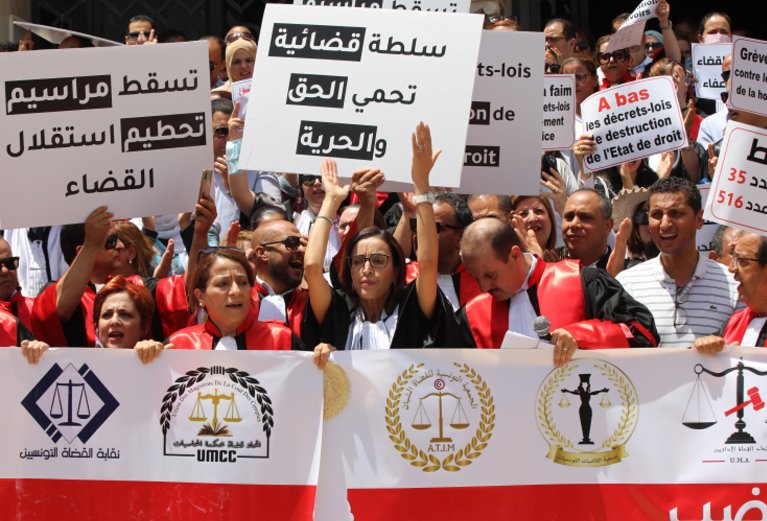
Local and international human rights organizations have called on Tunisian authorities to end what they describe as the intimidation of judges, coinciding with the trial of the head of the Judges' Association, Anas Hammadi, accused of 'obstructing freedom of work.' Hammadi appeared before the court on Thursday, where the court decided to postpone the trial at the request of the defense team.
The executive office of the Judges' Association expressed its deep concern over the proceedings of the trial, indicating that these actions pose a threat to the independence of the judiciary in Tunisia. These calls come at a sensitive time for the country, as fears grow regarding the decline of rights and freedoms.
Details of the Event
The current case involves Anas Hammadi, who symbolizes the efforts of judges to defend their independence and rights. He was arrested earlier, provoking strong reactions from local and international human rights organizations. While Tunisian authorities continue to take actions against judges, concerns arise about the impact of this on the judicial system as a whole.
The trial of Hammadi is part of a series of measures taken by the government against judges, which include arrests and threats. Many human rights organizations, such as Amnesty International and Human Rights Watch, have expressed their concern over these developments, considering them a violation of human rights.
Background & Context
Historically, Tunisia has faced significant challenges in the field of human rights, especially following the revolution that ousted the Ben Ali regime in 2011. Despite progress made in some areas, recent years have witnessed a notable decline in public freedoms, including freedom of expression and judicial independence.
The Tunisian government is currently seeking to control judicial institutions, raising widespread concern among human rights circles. Many organizations consider these steps aimed at undermining judicial independence and subordinating it to the executive authority.
Impact & Consequences
The repercussions of this trial extend beyond Tunisia, raising fears that it could lead to a greater decline in human rights in the region. If the government continues to take actions against judges, this could foster a culture of fear and intimidation, negatively impacting the judicial system and undermining public trust in it.
These events may also affect Tunisia's international relations, as they could raise concerns among countries and international organizations regarding Tunisia's commitment to human rights. Such pressures could lead to sanctions or diplomatic actions against the Tunisian government, increasing its isolation on the international stage.
Regional Significance
The issue of judges in Tunisia serves as an example of the challenges facing judicial systems in many Arab countries. Amid political and economic crises, the need to protect judicial independence emerges as a fundamental condition for achieving justice and equality.
Calls for the enhancement of human rights and public freedoms are increasing in the Arab region, and what is happening in Tunisia serves as a real test for these calls. If Tunisia can maintain the independence of its judiciary, it may become a model for other countries in the region.
In conclusion, the issue of judges in Tunisia remains in the spotlight of the world, representing a true test of the government's commitment to human rights and judicial independence. Continued pressure on judges could have dire consequences for Tunisia's future and its role in the region.