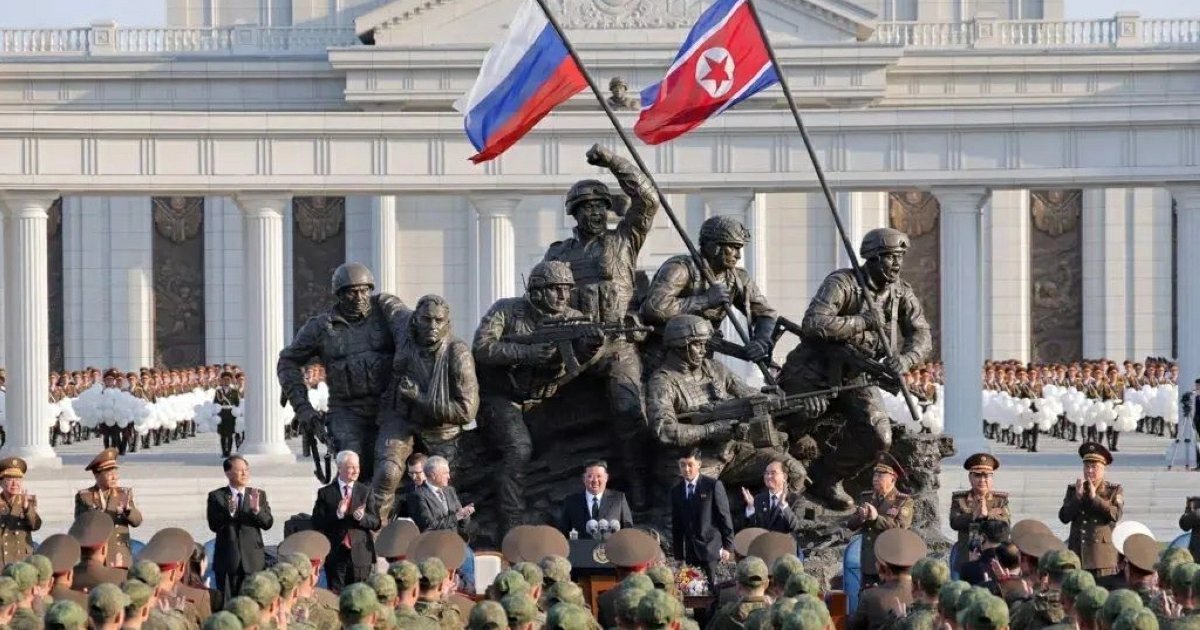
North Korean leader Kim Jong Un and Russian Defense Minister Andrei Belousov inaugurated a memorial museum in the capital Pyongyang, dedicated to the North Korean soldiers who fell while participating in the fight alongside Russia against Ukraine. The opening ceremony took place on Sunday, marking the first anniversary of the end of the military operation aimed at liberating the Russian region of Kursk.
The inauguration was also attended by the Chairman of the Russian Parliament Vyacheslav Volodin, a close ally of Russian President Vladimir Putin. The Korean Central News Agency confirmed that the museum aims to commemorate the soldiers who lost their lives in this war, where it is believed that North Korea sent approximately 15,000 soldiers to Ukraine, of whom around 2,000 were killed.
Event Details
In his speech during the inauguration, Kim Jong Un noted that the souls of the North Korean soldiers will remain a symbol of the "heroism of the Korean people," calling for support for the "victorious march of the Korean and Russian peoples." He also praised the North Korean and Russian forces for defending what he described as the "Western hegemony scheme led by the United States" in the Russian-Ukrainian conflict.
Kim held a separate meeting with Belousov, where he reaffirmed North Korea's full support for Russia's policies in defending its national sovereignty and security interests. Kim expressed confidence that Russia would achieve a "certain victory in this holy war," referring to the ongoing conflict in Ukraine.
Background & Context
The military relations between North Korea and Russia date back to the Cold War, where the two countries were allies against Western influence. As tensions in the region escalated, especially following the Russian invasion of Ukraine, North Korea began to strengthen its military cooperation with Russia. In June 2024, Kim and Putin signed an agreement for mutual support in the event of aggression against either country.
In April 2025, North Korea and Russia announced the deployment of their forces to confront a Ukrainian attack on the Kursk region, reflecting the depth of military cooperation between the two countries. North Korea also pledged to send thousands of workers to assist in rebuilding the area after the conflict.
Impact & Consequences
The opening of this museum is seen as a symbolic step reflecting the strengthening of relations between North Korea and Russia, at a time when international pressures on both countries are increasing. This move could also enhance military cooperation between them, potentially altering the dynamics of the conflict in the region.
Concerns are growing that this cooperation could escalate the conflict in Ukraine, as Russia bolsters its military position in the face of Western pressures. Additionally, North Korea's support for Russia may encourage other countries to adopt similar stances, complicating the geopolitical landscape further.
Regional Significance
This event illustrates how military alliances can impact regional and international stability. As Arab countries seek to achieve security and stability, the increasing cooperation between nations like North Korea and Russia may raise concerns about its implications for Arab interests in the region.
It is crucial for Arab nations to closely monitor these developments, especially amid ongoing tensions in other parts of the world. Military cooperation between non-Western countries could shift the balance of power, necessitating a strategic response from Arab states.