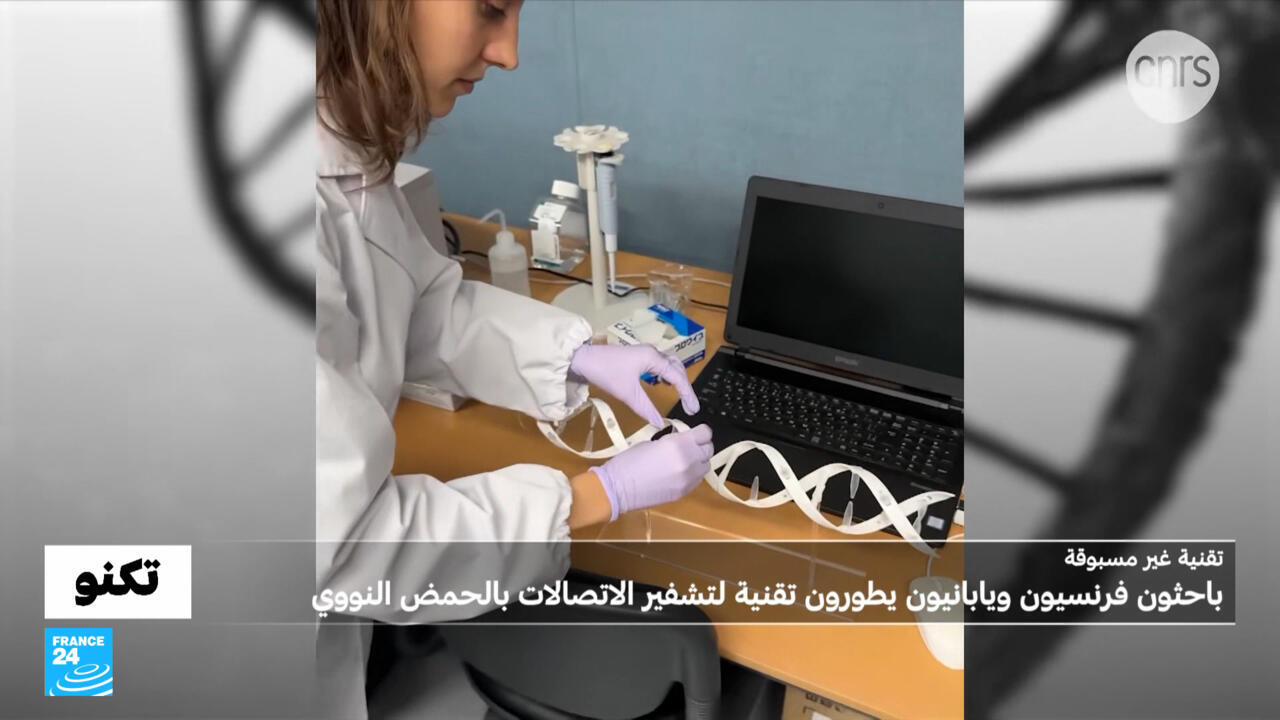
A team of researchers from France and Japan has unveiled an innovative technology for encrypting messages and securing communications during French President Emmanuel Macron's visit to Japan. This technology represents a significant leap in the field of digital communications, relying on the use of DNA as a means to encrypt information.
This step is the result of joint efforts between scientists from both countries, who have developed a system capable of converting digital data into a sequence of DNA, allowing for more secure and efficient information storage. This new method not only enhances security but also opens new horizons for storage technologies.
Event Details
This technology was announced during a joint press conference between President Macron and his Japanese counterpart, highlighting the importance of international cooperation in the fields of scientific research and technology. Scientists noted that using DNA for data encryption could provide higher security levels compared to traditional methods, making it an ideal choice for sensitive communications.
This technology is part of a global trend towards enhancing cybersecurity, especially in light of increasing electronic threats. The new system has been successfully tested in several scenarios, boosting its chances of adoption in the near future.
Background & Context
These developments come at a time when the world is witnessing a notable increase in cyberattacks, making the need for advanced security technologies more urgent. In recent years, we have seen numerous incidents leading to the leakage of sensitive data, prompting governments and companies to seek innovative solutions.
Historically, data encryption technologies relied on complex mathematical algorithms, but with advancements in biological sciences, it has become possible to use DNA as a means of storing information. This idea is not entirely new; however, it has become more feasible thanks to recent technological advancements.
Impact & Consequences
If this technology is widely adopted, it could revolutionize how information is secured. These innovations could lead to improved security in various fields, including military communications, financial services, and e-commerce.
Additionally, this technology may contribute to enhancing cooperation between countries in research and development, leading to improved international relations. It is expected that these innovations will attract the interest of major technology companies, potentially leading to significant investments in this field.
Regional Significance
Given the increasing security challenges in the Arab region, this technology could be beneficial in enhancing cybersecurity for Arab countries. Governments and companies in the region can play a role in adopting these innovations to secure their data and protect it from threats.
Furthermore, this technology could foster collaboration between Arab countries and developed nations in the field of technology, opening new avenues for development and innovation in the region.
Innovations in data encryption represent an important step towards a safer future and underscore the importance of international cooperation in addressing global challenges. As this technology continues to evolve, positive impacts are expected across various sectors.