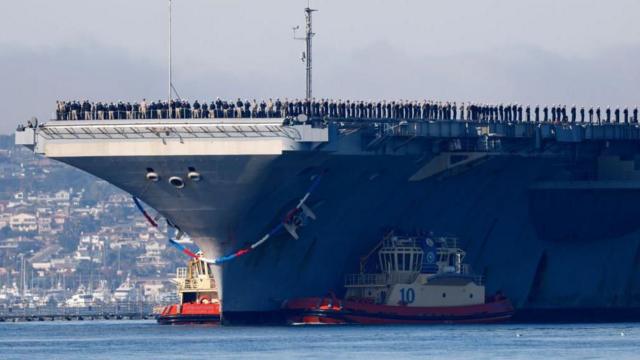
The Iranian Navy announced on Wednesday that it had executed a cruise missile launch targeting the US aircraft carrier Abraham Lincoln, in a move that reflects escalating tensions between Tehran and Washington. The Iranian Navy confirmed that this strike was part of military exercises, warning of the possibility of further attacks if necessary.
According to a military statement issued by the Iranian Navy, the launched missiles forced the US aircraft carrier, which is located in the Gulf region, to "change its position." Admiral Shahram Irani, the commander of the Iranian Navy, explained that the movements of the carrier are being closely monitored, reflecting a state of military alert in the region.
Details of the Incident
These developments come at a sensitive time, as relations between Iran and the United States are experiencing heightened tensions, particularly following Washington's withdrawal from the Iranian nuclear deal in 2018 and the re-imposition of economic sanctions on Tehran. These measures have added to the instability in the Gulf region, which is considered one of the most sensitive areas in the world.
It is noteworthy that the aircraft carrier Abraham Lincoln had been deployed to the region as part of the United States' strategy to bolster its military presence in light of increasing Iranian threats. This incident serves as a clear message from Iran that it possesses the capability to target US forces in the region, complicating the security situation further.
Background & Context
Historically, the Gulf region has been a focal point for major powers, given its vast reserves of oil and gas. The area has witnessed numerous military and political crises, ranging from the Gulf War in the 1990s to ongoing conflicts in Iraq and Syria. Iran is a key player in these dynamics, seeking to enhance its influence in the region by supporting allies such as Hezbollah in Lebanon and the Houthis in Yemen.
In recent years, Iran has increased its military capabilities, including cruise missiles, which it considers part of its defensive strategy. This has raised concerns among Western nations, fearing that it could escalate conflict in the region.
Impact & Consequences
These events could lead to an escalation of military tensions between Iran and the United States, which may adversely affect regional security. If Iran continues to carry out such operations, it could provoke a military response from the United States, increasing the likelihood of armed conflict.
Moreover, rising tensions could impact global oil prices, as the global economy heavily relies on oil supplies from the Gulf region. Any disruptions in these supplies could lead to price hikes and increased economic pressures on consumer countries.
Regional Significance
Arab countries in the Gulf region, such as Saudi Arabia and the United Arab Emirates, are among the most affected by the escalating tensions between Iran and the United States. These nations fear that any military confrontation could destabilize them, especially amid the economic and political crises they are facing.
Additionally, these events may affect relations between Arab countries and Iran, as some nations may seek to strengthen their alliances with the United States in the face of Iranian threats. Conversely, Iran may attempt to bolster its influence in the region by supporting armed groups, further complicating the security landscape.
In conclusion, the situation in the Gulf region remains tense, necessitating effective diplomatic dialogue to avoid any escalation that could lead to armed conflict. Recent events indicate that the region is still at the heart of global crises, requiring ongoing international attention.